Red Flags to Watch Out for When Choosing a Pre-school in Singapore
Red Flags to Watch Out for When Choosing a Pre-school in Singapore
Choosing a pre-school for your child is one of the most consequential decisions you will make in the early years. The right setting shapes language, confidence, curiosity, and the social skills your child will carry into primary school and beyond. But with dozens of centres competing for your attention, each with glossy websites and carefully curated open-house experiences, it is easy to be impressed by surface details while missing the things that truly matter.
The good news is that genuinely strong pre-schools are not hard to identify once you know what to look for. And the concerning ones tend to display consistent warning signs, if you know where to look. This guide walks you through the seven most important red flags Singapore parents should watch for when evaluating a pre-school, covering everything from physical safety and teacher quality to curriculum depth, language strategy, and future-readiness. Read it before your next school tour and take it with you as a mental checklist.
Why the Brochure Is Never Enough
Pre-school marketing in Singapore is sophisticated. Centres invest in professional photography, warm copywriting, and impressive credential lists. None of this is inherently dishonest, but it does mean that the brochure, website, and even the guided tour tell only part of the story. The Early Childhood Development Agency (ECDA) sets minimum licensing standards across all pre-schools in Singapore, and meeting those standards is a legal requirement, not a mark of excellence. What distinguishes a truly outstanding programme from a merely compliant one shows up in the details: how a teacher kneels beside a distressed child, whether the daily schedule allows genuine exploration, and whether staff can clearly explain the thinking behind what they teach.
The seven red flags below are grounded in those details. They cover areas where the gap between a pre-school’s promises and its daily reality tends to be widest. As you visit, observe how staff behave when they do not know you are watching, ask questions that require specific rather than scripted answers, and trust the cumulative picture over any single interaction.
ChildFirst Parent Guide
7 Red Flags to Watch For When Choosing a Pre-school in Singapore
What to look for beyond the glossy brochure.
🏚️
Neglected Environment
Dirty surfaces, broken equipment, and inadequate outdoor space suggest that upkeep is not a priority.
😶
Disengaged Teachers
Teachers on phones, avoiding eye contact with children, or unable to name individual pupils.
📄
Worksheet-Heavy Curriculum
Rows of children completing identical paper tasks instead of exploring and discovering together.
🌐
No Language Strategy
Vague answers about how language exposure is structured across the day.
🔒
Hidden Policies
No written handbook, unclear fee structures, or evasive responses to direct questions.
📋
No Accreditation
Unable to provide ECDA licence details or evidence of SPARK or Healthy Pre-school status.
🔭
No Future Vision
Curriculum stuck in the past, with no plan to develop skills relevant to an AI-shaped world.
ChildFirst • Trilingual AI + HI + MI Curriculum • Singapore Pre-school.
Red Flag 1: An Unsafe or Neglected Physical Environment
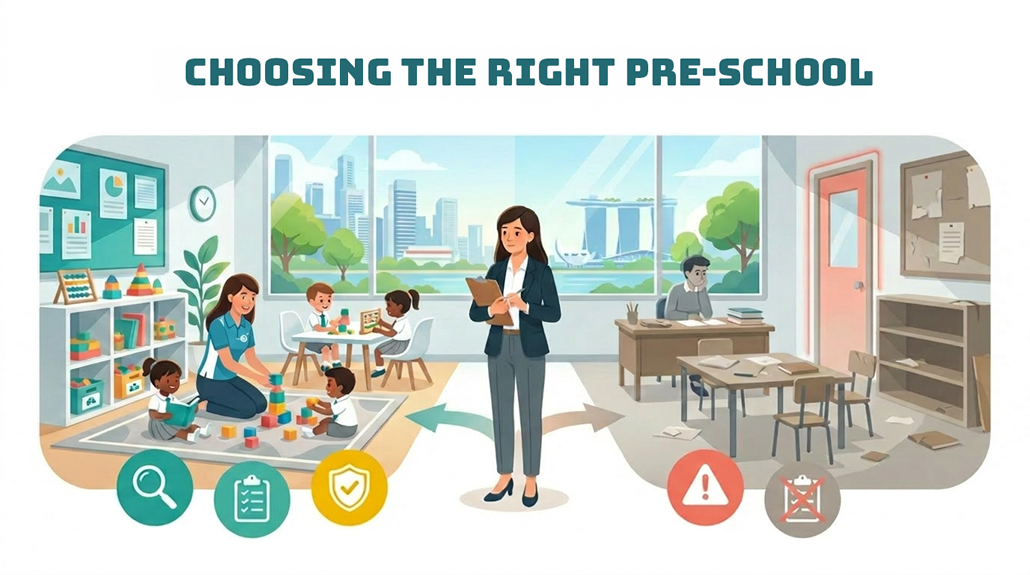
The state of a pre-school’s physical space is one of the clearest signals of its overall standards. A well-run centre will be clean, organised, and visibly adapted to children’s needs, with age-appropriate furniture, secure storage for hazardous materials, and outdoor areas that are shaded and well-maintained. What you are looking for is not a pristine showroom. Active learning environments are lively and lived-in, with children’s artwork on the walls and materials in use. What you should be concerned about is neglect: sticky surfaces, broken equipment left unrepaired, persistent unpleasant odours, or toilets that have not been properly cleaned.
Pay particular attention to safety basics. Electrical sockets near children’s height should be covered. Cleaning products and medicines must be locked away. Staircase gates should be secure. If you notice small objects accessible to infants and toddlers, windows that young children could reach, or unstable shelving, these are not minor oversights. They indicate that safety checks are not being carried out consistently. Also note whether the space allows children to move freely. ECDA sets minimum space-per-child requirements, but some centres crowd classrooms right up to those limits. Insufficient space does not just feel uncomfortable; it restricts the kind of active, exploratory learning that young children need.
Red Flag 2: Teachers Who Are Disengaged or Underqualified
No aspect of a pre-school matters more than its teachers. Research into early childhood education consistently shows that the quality of adult-child interactions is the single strongest predictor of outcomes. During your visit, observe how educators move through the room. Are they at children’s eye level, using their names, and responding warmly to questions? Or are they managing the group from a distance, scrolling through phones, or speaking to children in sharp, dismissive tones? A single rushed interaction should not condemn a centre, but a pattern of passive supervision is a serious warning sign.
Ask directly about teacher qualifications. In Singapore, educators should hold recognised early childhood certifications, such as a Diploma in Pre-school Education (Teaching) or equivalent. A strong centre will also invest in ongoing professional development, because the field of early childhood education continues to evolve. High staff turnover is another red flag worth probing. If several teachers have left within the past year, ask why. Frequent departures usually reflect either poor working conditions or weak leadership, both of which affect the stability and security your child depends on.
ECDA mandates minimum teacher-to-child ratios: 1:8 for children aged 18 months to 3 years, 1:12 for ages 3 to 4, and 1:15 for ages 4 to 6. Quality centres often keep their ratios lower than these thresholds so that teachers can give children genuine individual attention. If a centre cannot confirm its current ratios or if those numbers feel uncomfortably high during your visit, take note.
Red Flag 3: A Curriculum That Ignores How Children Actually Learn
Young children learn through play, movement, conversation, creativity, and meaningful interaction with the world around them. A curriculum designed around these principles will look active and varied: children negotiating roles in a pretend play scenario, building and rebuilding a construction, making predictions in a simple science activity, or moving their bodies to explore rhythm and pattern. When a programme instead relies heavily on worksheets, rote memorisation, and teacher-directed drills for children under six, it is working against the grain of child development rather than with it.
Be alert to curricula that focus almost entirely on literacy and numeracy at the expense of other domains. Social-emotional development, creative expression, physical coordination, and problem-solving are not extras to be squeezed in around the academic programme. They are equally foundational. Ask the centre how they accommodate children who are at different developmental stages. If the answer is vague or suggests that all children follow an identical programme regardless of readiness, that is a concern. The best curricula are designed to recognise and respond to individual differences rather than expecting every child to fit a single mould.
A forward-looking pre-school will also incorporate multiple intelligences development into its approach, acknowledging that children think, learn, and express themselves in genuinely different ways, whether through language, spatial reasoning, music, movement, or interpersonal connection. A curriculum that only values one or two types of ability will leave many children feeling that they are not smart enough, when the truth is simply that their strengths have not yet been seen.
Red Flag 4: No Clear Language Development Strategy
In Singapore’s multilingual context, a pre-school’s approach to language development deserves scrutiny well beyond a simple listing of the languages taught. Many centres list bilingual or even trilingual programmes in their marketing, but if you ask how language exposure is structured throughout the day, the answers can be surprisingly thin. Watch out for centres where one language dominates almost all interactions while others are confined to a single weekly class. Meaningful language acquisition requires consistent, immersive exposure across play, instruction, and daily routines, not token appearances on the timetable.
For families who want their child to develop genuine English proficiency, ask how the English language environment is structured and whether native-speaking or highly proficient English educators are consistently present. The same questions apply to Mandarin: ask about the qualifications of Mandarin teachers and how much of the day is genuinely conducted in Chinese. A centre that is serious about Chinese pre-school trilingual learning will be able to describe its approach in specific, confident terms.
Forward-thinking pre-schools have also begun to treat coding as a genuine third language, recognising that the ability to understand and communicate through computational thinking will be as essential to your child’s future as spoken language fluency. If a centre has no articulated approach to coding within its language and learning framework, it may not be preparing children for the realities ahead.
Red Flag 5: Poor Communication and Hidden Policies
How a pre-school communicates with families before enrolment tells you a great deal about how it will communicate once your child is enrolled. Pay attention to whether staff listen carefully to your questions or respond with rehearsed marketing answers. Notice whether they follow up on information requests promptly, or whether important details require chasing. Evasiveness at this stage rarely improves after you have signed the papers.
Specific red flags to watch for include: no written parent handbook or clearly documented policies; vague or shifting fee structures with unexpected additional charges; and a reluctance to allow drop-in visits after enrolment. Quality centres welcome parental involvement and have nothing to hide. They offer specific, substantive updates about your child’s day rather than generic summaries, and they handle concerns professionally rather than becoming defensive when a parent raises a question. If your instinct during the enrolment process is that information is being withheld or managed rather than shared openly, trust that instinct.
Red Flag 6: Missing Accreditation and Compliance Records
Every pre-school operating in Singapore must hold a valid ECDA licence. This is non-negotiable, and you can verify a centre’s licence status directly through the ECDA website. Any history of serious compliance violations, provisional licensing, or regulatory action is a significant red flag that should not be explained away. Beyond the legal baseline, look for centres that have pursued voluntary quality frameworks. The Singapore Pre-school Accreditation Framework, widely known as SPARK, evaluates a pre-school’s leadership, curriculum, environment, and family partnerships against a rigorous national standard. Similarly, the Healthy Pre-school accreditation recognises centres that embed physical wellness and healthy habits into their daily programme.
A centre that cannot readily share its ECDA licence details or that becomes vague when asked about SPARK status is either not accredited or is not proud of its record. Either way, that is worth knowing before you commit. Accreditation does not guarantee a perfect experience, but it does indicate that the centre has submitted itself to external scrutiny and met a defined standard of quality, which is meaningfully different from a centre that has done neither.
Red Flag 7: No Vision for Your Child’s Future
This is the red flag that many parents do not think to look for, yet it may be the most consequential of all. The children starting pre-school today will enter the workforce in a world where artificial intelligence is embedded in nearly every industry and profession. A pre-school that has no considered response to this reality, that is teaching the same curriculum it used a decade ago with no investment in future-relevant skills, is preparing children for a world that will not exist when they grow up.
Ask a prospective centre directly: how are you preparing children for a future shaped by artificial intelligence? A strong answer will describe a programme that develops both technical understanding and the irreplaceable human capacities that AI cannot replicate: creativity, empathy, critical thinking, communication, and the confidence to keep learning as the landscape shifts. A poor answer will be a blank stare, a pivot to academic credentials, or a vague claim about “21st-century skills” without any substance behind it.
Look for centres that have integrated age-appropriate artificial intelligence literacy into their curriculum alongside a clear commitment to nurturing human intelligence: the creativity, collaboration, and emotional depth that makes each child genuinely irreplaceable. A curriculum that develops both is not a luxury. It is the standard your child deserves.
What to Do After You Spot a Red Flag
One concern in isolation does not necessarily disqualify a centre. A single understaffed afternoon, a classroom in mid-renovation, or a teacher having a difficult day can produce a misleading snapshot. What you are looking for is a pattern: multiple red flags appearing across different areas, the same concern surfacing in two separate visits, or an administrator who becomes defensive when you raise a reasonable question. If you see a cluster of warning signs, trust what the evidence is telling you.
Practical steps to take before making your final decision include visiting more than once and at different times of day, speaking with parents whose children are already enrolled (not just parents the centre refers you to), and asking specific rather than open-ended questions during the tour. Instead of “Tell me about your curriculum”, ask “Can you walk me through what a typical Tuesday looks like for a four-year-old here?” Specific questions generate specific answers, and the specificity of those answers tells you a great deal about how well a centre actually knows its own practice.
After enrolment, stay engaged. Continue noticing how your child talks about school, whether the enthusiasm holds, and whether the updates you receive from teachers feel substantive and personalised. A quality pre-school will welcome your ongoing involvement rather than treating it as an intrusion. The years from 18 months to 6 years old are among the richest periods of human development. Your child deserves a setting that truly honours that.
The Bottom Line
Choosing a pre-school is not simply about finding a safe place for your child to spend the day. It is about finding a learning community that sees your child’s full potential, builds the skills they will need for a changing world, and partners with your family every step of the way. The red flags in this guide are not meant to make the search feel overwhelming. They are tools to help you filter confidently, so that when you do find the right fit, you can feel certain rather than just hopeful.
A pre-school with qualified and warm teachers, a thoughtfully designed curriculum, a genuine trilingual strategy, strong accreditation, and a clear vision for future-readiness is not asking for more than any child deserves. It is simply what the evidence says early childhood education should be.
ChildFirst Pre-school
See What a Future-Ready Pre-school Looks Like in Person
ChildFirst is an award-winning, SPARK-certified pre-school designed around a unique trilingual AI, Human Intelligence, and Multiple Intelligences curriculum. Our Ednoland curriculum technology and EdnoAI applications bring learning to life in ways that prepare children for the world ahead, while ensuring they grow in warmth, creativity, and confidence. We welcome families to visit our centres at Hillview and Tampines and see for themselves.
ChildFirst • Trilingual AI + HI + MI Curriculum • Singapore Pre-school.