What Makes a Good Pre-school Teacher? A Parent’s Guide
The moment you drop your child off at pre-school for the very first time, a quiet question settles in the back of your mind: Is the teacher going to truly see my child? Not just manage the classroom, not just run through the day’s activities, but actually notice who your child is, what excites them, what challenges them, and what they are quietly capable of becoming. That question matters enormously, because research in early childhood education consistently shows that the quality of the teacher-child relationship is one of the strongest predictors of a child’s academic confidence, social resilience, and long-term love of learning.
Yet with so much focus on facilities, curricula, and location when comparing pre-schools, the qualities of the educators themselves can easily slip down the checklist. This article is designed to bring those qualities back to the top. Whether you are evaluating a pre-school for the first time or reconsidering your current choice, understanding what a great pre-school teacher actually looks like in practice will give you a much clearer framework for making the right decision for your child.
Why the Teacher Matters More Than the Classroom
Gleaming facilities and a well-equipped sensory room are wonderful, but they are ultimately just a backdrop. The teacher is the environment. Before a child can absorb a single phonics lesson or science experiment, they need to feel safe, seen, and valued by the adult in the room. Developmental psychologists describe this as the foundation of a secure learning attachment: when a child trusts their teacher, their nervous system relaxes, their curiosity activates, and genuine learning becomes possible.
This is particularly significant in Singapore’s pre-school landscape, where early childhood programmes are becoming increasingly diverse and enriched. Parents today are choosing between enrichment-only centres, bilingual programmes, and full trilingual learning environments. The sophistication of the curriculum can only translate into real growth for a child when it is delivered by an educator with the right blend of human qualities, pedagogical training, and personal warmth. A great pre-school teacher is, in every meaningful sense, irreplaceable.
Core Qualities of a Great Pre-school Teacher
Warmth and Genuine Patience
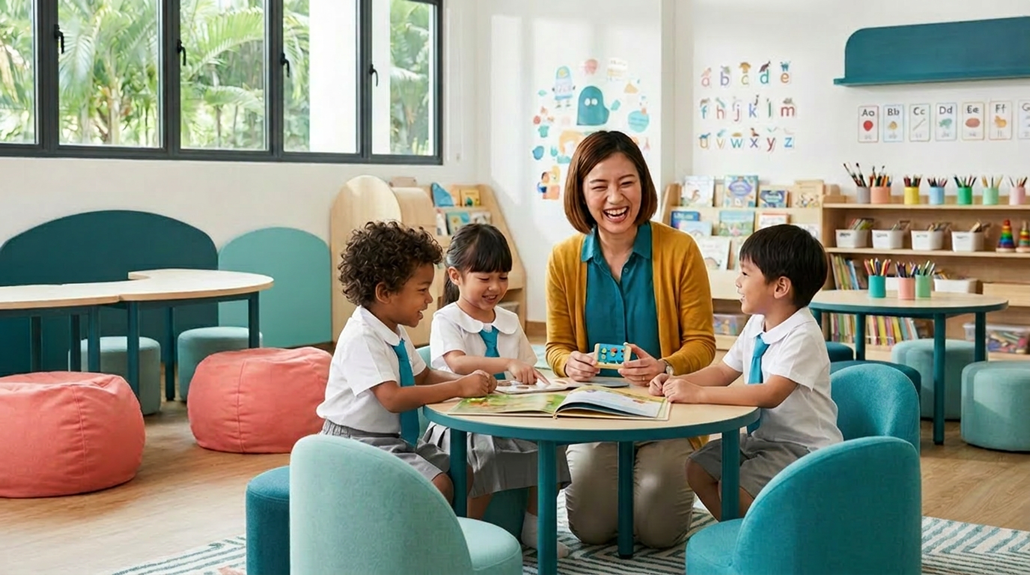
Warmth is not the same as being cheerful all the time. A genuinely warm educator is attuned to a child’s emotional state, responds to distress without dismissing it, and creates a consistent sense of physical and emotional safety. Young children, especially those between 18 months and 4 years, are still forming their understanding of whether adults can be trusted. A teacher who greets each child by name, crouches to eye level during conversations, and responds to tears with calm steadiness sends a powerful, repeated message: “You are safe here.”
Patience in this context means more than tolerating a slow pace. It means resisting the urge to rescue a child from a problem they are on the verge of solving independently, waiting through a long silence while a shy child finds their words, and remaining regulated when a group of 3-year-olds simultaneously decides that circle time is optional. This kind of patience is a practised, intentional skill, and it is one of the clearest markers that separates a good pre-school teacher from a great one.
Sharp Observation Skills
Great early childhood educators are, at heart, keen observers. They notice that one child consistently gravitates toward building blocks and spatial puzzles, that another child lights up during music but struggles to sit through a reading activity, and that a third child who appears disengaged is actually processing intently before acting. These observations are not incidental; they are the raw material from which truly personalised teaching is built.
This connects directly to the theory of Multiple Intelligences, developed by developmental psychologist Howard Gardner at Harvard. Gardner’s framework identifies at least eight distinct intelligence profiles: Linguistic, Logical-Mathematical, Spatial, Musical, Bodily-Kinesthetic, Interpersonal, Intrapersonal, and Naturalist. A skilled pre-school teacher recognises that a child who seems uninterested in pencil-and-paper tasks may be highly Bodily-Kinesthetic, thriving when lessons involve movement, construction, or hands-on exploration. At ChildFirst, our Multiple Intelligences curriculum is specifically designed to equip teachers with this observational lens so that every child’s strengths are identified and nurtured from the earliest stages.
Clear, Encouraging Communication
The language a teacher uses with young children shapes the way those children come to see themselves as learners. Process-focused praise, such as “I can see how hard you worked on that puzzle” rather than “You are so clever”, builds resilience and a growth mindset. Encouraging communication also means narrating experiences aloud, expanding vocabulary naturally within context, and asking open-ended questions that invite children to think rather than simply recall. Saying “Oh, that didn’t work, let’s figure out why!” after a block tower falls teaches a child that mistakes are a productive part of learning, not a signal of failure.
In a trilingual environment like ChildFirst’s, communication quality takes on an additional dimension. Teachers who can move fluidly and confidently across English, Mandarin, and Coding as a third language create an immersive, natural language experience that mirrors how children actually acquire language rather than learning it in isolation. Parents looking for pre-schools that prioritise language development will find it worthwhile to ask specifically about how teachers are trained to scaffold multilingual communication in the classroom.
A Genuine Love of Learning and Curiosity
Children are extraordinarily good at detecting authenticity. A teacher who is genuinely fascinated by a caterpillar found in the garden, or who approaches a new science activity with real curiosity, invites children into that sense of wonder far more powerfully than any lesson plan alone can. This quality, sometimes described as intellectual vitality, is difficult to teach but easy to spot: you see it in the way a teacher leans in during a child’s discovery, asks a follow-up question rather than supplying an answer, and treats every unexpected moment as a learning opportunity rather than a disruption.
This quality also sustains teachers through the physical and emotional demands of early childhood education. Educators who remain genuinely curious about children and about their own practice are more likely to pursue professional development, to stay current with research, and to adapt as new evidence about child development emerges. When you visit a pre-school, pay attention to whether teachers speak about their work with energy and specificity, or whether they rely on generic phrases about “nurturing young minds”.
Adaptability and Creativity in Teaching
No two days in a pre-school classroom unfold as planned, and no two children respond to the same teaching moment in the same way. Adaptability is therefore not a bonus quality; it is a core professional skill. A creative, adaptable teacher can take a rainy afternoon that cancelled outdoor play and turn it into an impromptu exploration of sound, or pivot from a phonics lesson to an impromptu discussion when a child brings in a question that the whole group becomes absorbed by.
Creativity in teaching also means finding multiple pathways to the same learning goal. A child who does not connect with a particular activity the first time does not have a deficiency; they need a different entry point. Teachers who are resourceful and inventive will find that entry point, drawing on art, music, storytelling, movement, or technology as the moment calls for it. This is especially relevant in programmes that integrate technology meaningfully, where teachers must balance screen-based tools with embodied, hands-on experience rather than defaulting to one over the other.
Deep Understanding of Child Development
A great pre-school teacher understands what is developmentally typical at each stage, which means they are neither alarmed by normal developmental variation nor blind to signs that a child might benefit from additional support. They know that a 2-year-old’s parallel play is not antisocial behaviour, that a 4-year-old’s elaborate fantasy world is healthy Intrapersonal and Linguistic intelligence at work, and that frustration before mastery is a normal and necessary part of cognitive growth.
This developmental knowledge also informs how teachers design experiences that sit at the right level of challenge: not so easy that children disengage, and not so difficult that they become overwhelmed. The concept of the “zone of proximal development”: the space between what a child can do independently and what they can achieve with a little guidance, is where skilled early childhood educators do their most important work. Look for teachers who can articulate why they set up activities in particular ways, because that articulacy signals genuine understanding rather than habit.
At ChildFirst, this developmental understanding is embedded into our Human Intelligence curriculum, which focuses on nurturing the uniquely human capacities – empathy, creative reasoning, emotional regulation, and collaborative problem-solving – that no technology can replicate. These are not supplementary goals; they are the foundation of everything else a child will learn.
Commitment to Parent Partnership
The relationship between a pre-school teacher and a child’s family is one of the most underrated factors in early learning. Parents hold irreplaceable contextual knowledge about their child: how they slept the night before, what they are anxious about at home, what topics have caught their imagination recently. A teacher who actively seeks this information and reciprocates with specific, honest observations about the child’s day creates a genuine loop that benefits the child enormously.
Meaningful parent partnership goes beyond a newsletter or a termly report card. It shows up in a teacher who sends a quick note about a breakthrough moment during art, who flags a concern early and with compassion rather than waiting until it escalates, and who listens attentively when a parent shares something difficult. Seek pre-schools where parent communication is treated as a professional responsibility and not an afterthought.
Beyond the Individual Teacher: The Curriculum Behind the Classroom
Even the most gifted teacher works more effectively when the curriculum they are delivering is thoughtfully designed. A well-structured programme gives teachers clear frameworks, meaningful learning goals, and the freedom to personalise within those boundaries. When evaluating a pre-school, it is worth understanding not just who the teachers are, but what they are teaching with.
At ChildFirst, our educators deliver a three-pronged approach that combines Artificial Intelligence, Human Intelligence, and Multiple Intelligences development. This means teachers are equipped to guide children through technology-integrated learning using our Ednoland curriculum technology and EdnoAI applications, while simultaneously investing deeply in the creativity, empathy, and critical thinking that define irreplaceable human capability. The trilingual dimension, spanning English, Chinese, and Coding as the third language, adds a further layer of cognitive richness that well-trained teachers know how to weave naturally into daily learning rather than treating as a separate subject.
A strong curriculum is a teacher’s best professional partner. When schools invest in rigorous, developmentally grounded programmes alongside ongoing teacher training, the result is an environment where great teachers can do their best work consistently, rather than relying on individual brilliance alone.
Questions to Ask on Your Next School Tour
Knowing what to look for is one thing; knowing what to ask is another. When you visit a pre-school, consider moving beyond the standard questions about facilities and fees. The conversations that reveal most about teaching quality are often the ones that invite educators to talk about their practice in specific terms. Here are some questions worth raising:
- How do teachers get to know each child’s individual strengths and interests? Listen for specific answers about observation, documentation, and personalised planning rather than generic reassurances.
- How do teachers handle a child who is having a difficult day? This question reveals a great deal about emotional philosophy and whether the classroom culture genuinely supports children’s wellbeing.
- What ongoing professional development do teachers receive? A school that invests in its teachers’ growth is a school that takes quality seriously.
- How does the school communicate with families about their child’s progress? Find out whether updates are routine and formal, or warm and specific.
- Can you observe a session in progress? Watching teachers interact naturally with children, rather than presenting a formal demonstration, gives you the clearest picture of everyday classroom culture.
Trust your instincts as you listen. Parents often notice small signals that confirm or question the quality of a teaching environment: whether children look relaxed and engaged, whether the teacher refers to children by name with ease, whether the room feels energised rather than controlled. These impressions, alongside thoughtful questions, will guide you well.
Putting It All Together
Finding the right pre-school teacher for your child is not about finding someone perfect. It is about finding someone who is genuinely present, professionally grounded, warm without being permissive, and curious enough about each individual child to keep growing in their practice. The qualities explored in this article, from patient observation and adaptive creativity to deep developmental knowledge and authentic parent partnership, are the hallmarks of educators who do far more than mind children. They shape the way children see themselves as learners for years to come.
When a great teacher is supported by a curriculum that is equally thoughtful, designed to develop children across multiple dimensions rather than optimising for a single metric, the results can be genuinely transformative. That is the standard worth holding out for, and it is absolutely achievable.
The right teacher, in the right environment, with the right tools, does not just prepare your child for school. They prepare your child for life.
See Our Teachers and Curriculum in Action
The best way to evaluate a pre-school teacher is to see them at work. At ChildFirst’s centres in Hillview and Tampines, we welcome families to experience our trilingual AI, HI, and MI learning environment firsthand. Come and see how our educators bring warmth, expertise, and genuine curiosity into every session.
ChildFirst • Trilingual AI + HI + MI Curriculum • Singapore Pre-school.