Pre-school Open House Guide: How to Make the Most of Your Visit
A pre-school open house is your best opportunity to move beyond glossy brochures and websites and see a centre’s true character: the atmosphere in the classrooms, the warmth of the teachers, and the way children actually spend their days. Yet many parents leave open houses feeling uncertain, unsure whether they asked the right questions or noticed the details that matter most.
This guide is designed to change that. Whether you are visiting your first pre-school or your fifth, it will help you arrive prepared, observe with clarity, and leave with the information you need to make a confident, well-informed choice. From preparing your questions in advance to spotting the green flags that signal a genuinely nurturing environment, consider this your practical companion for every open house on your list.
Why Attending a Pre-school Open House Matters
A pre-school open house is far more than a marketing event. It is a structured opportunity for families to experience a centre’s culture first-hand, speak directly with educators, and assess whether the environment aligns with their child’s learning needs and their family’s values. Research in early childhood development consistently shows that the quality of the pre-school environment, including teacher-child interactions, physical space, and curriculum depth, has a lasting impact on a child’s cognitive and social development. Attending in person gives you direct access to all of these variables in a way that no website or information pack can replicate.
Open houses also give you a chance to compare different approaches side by side. Singapore’s pre-school landscape is diverse, ranging from play-based programmes to structured bilingual or trilingual curricula, to centres integrating technology into early learning. Walking through a centre, meeting the educators, and watching how staff interact with children during a visit will tell you far more than any ranking list or online review.
Before You Go: How to Prepare for Your Visit
A little preparation before open house day can make a significant difference. Start by clarifying your own priorities as a family. Are you looking for strong language development across multiple tongues? A curriculum that nurtures creativity and critical thinking alongside academic foundations? Proximity to home or workplace? Knowing what matters most to you helps you evaluate each centre against a consistent set of criteria, rather than being swayed by whichever school puts on the most polished presentation.
Before visiting, spend some time reviewing the pre-school’s website and any publicly available information about its curriculum, accreditations, and teaching philosophy. Check whether the centre holds relevant certifications such as the SPARK (Singapore Pre-school Accreditation Framework) certification from the Early Childhood Development Agency (ECDA), which signals adherence to quality standards in Singapore early childhood education. Note down two or three specific questions arising from what you read, in addition to your general checklist. Arriving with focused, informed questions signals genuine interest and tends to elicit more substantive answers from centre staff.
Practical logistics matter too. Try to attend the open house at a time when you are not rushed. If possible, block out the rest of the morning or afternoon so you can observe at a relaxed pace rather than watching the clock. Bring a notebook or use your phone’s notes app to record impressions while they are fresh. Memories of multiple centres can blur together quickly, and having written notes to compare later is genuinely useful.
During the Visit: What to Look For
When you walk through the doors, resist the urge to focus only on the physical facilities. Beautiful classrooms matter, but the quality of human interactions within those rooms matters far more. Observe how teachers speak to children: do they get down to the child’s eye level, listen attentively, and respond with warmth and patience? Do children appear engaged, curious, and comfortable, or do they seem passive, restless, or anxious? The emotional tone of a classroom is one of the most reliable indicators of its quality.
The Learning Environment
Look beyond surface aesthetics. Are learning materials varied, age-appropriate, and accessible to children, or are they stored away out of reach? Is there evidence of ongoing projects, creative work, or child-initiated displays on the walls, rather than purely teacher-produced decorations? A classroom where children’s own thinking is made visible suggests a curriculum that values curiosity and process, not only correct outcomes.
Pay attention to outdoor or movement spaces as well. Young children require regular physical activity and sensory play for healthy development. A well-designed centre will have dedicated space for children to move, explore, and take safe, appropriate risks through active play.
The Curriculum in Practice
Ask to see a sample daily schedule and, if possible, observe a learning session in progress. There is a meaningful difference between a curriculum that sounds compelling in a brochure and one that is genuinely brought to life in the classroom. A strong early childhood curriculum will balance structured learning with child-directed exploration, integrate language development across different contexts, and adapt to the range of abilities and interests present in a class. If a centre describes a distinctive pedagogical approach, such as a trilingual model, multiple intelligences framework, or technology-integrated learning, ask the educators to show you specific examples of how this plays out in daily practice.
Safety, Hygiene, and Health Standards
Check that the physical environment is clean, well-maintained, and child-safe. Surfaces, toileting areas, and food preparation spaces should be hygienic and clearly managed with consistent protocols. If the centre holds Healthy Pre-school accreditation, ask how this standard is maintained in day-to-day routines, from meal planning to physical activity guidelines.
Key Questions to Ask at a Pre-school Open House
A prepared list of questions is one of the most valuable tools you can bring to an open house. The following cover the areas that most directly affect your child’s experience and development.
- Curriculum and learning approach. What is the underlying philosophy guiding how children learn here? How does the programme balance academic skill-building with social-emotional development? How does the curriculum adapt to children who are ahead or behind their peers in specific areas?
- Language development. If trilingual or bilingual learning is offered, how is each language introduced and reinforced? What qualifications do mother-tongue and language teachers hold, and how much immersive exposure does each language receive across the week?
- Teacher qualifications and stability. What are the required qualifications for classroom educators? What is the average length of service for teachers at this centre? High staff turnover can disrupt the continuity and security that young children need.
- Class sizes and ratios. What is the adult-to-child ratio in each class? Smaller ratios typically allow teachers to provide more individual attention and respond more thoughtfully to each child’s needs.
- Communication with families. How does the centre keep parents informed about their child’s progress and daily experiences? Are there regular parent-teacher meetings, digital updates, or portfolio reviews?
- Technology in learning. If the centre integrates technology into its curriculum, ask how it is used intentionally to support learning rather than simply as a screen-time substitute. What safeguards are in place to ensure age-appropriate and purposeful use?
- Transition support. How does the centre help children transition between age groups or prepare for primary school? Is there a structured K1 and K2 readiness programme?
Green Flags and Red Flags to Watch Out For
Knowing what genuinely signals quality, versus what is simply good marketing, takes a little practice. Here are some reliable indicators to guide your observations.
Green Flags
- Educators who speak about children individually. When teachers refer to specific children by name and describe their particular interests or learning style during your tour, it signals that they genuinely know and pay attention to each child.
- Transparent answers to difficult questions. A confident, quality centre will answer your questions about challenges, transitions, and complaints procedures openly, rather than deflecting or over-promising.
- Children who look comfortable and purposeful. Children engaged in self-chosen activity, cooperating with peers, or absorbed in a task are typically signs of a well-regulated, secure classroom environment.
- Curriculum that is coherently explained. Educators who can articulate why they do what they do, not just what they do, demonstrate genuine pedagogical depth.
Red Flags
- Vague or evasive responses to direct questions. If questions about teacher qualifications, ratios, or curriculum specifics are met with generalities or subject changes, treat this as a concern.
- An overemphasis on academic drills for very young children. Rote memorisation and worksheets as the dominant mode of learning for toddlers and pre-schoolers is not consistent with best-practice early childhood education.
- High staff turnover or many unfamiliar faces. If the open house is hosted primarily by administrative staff who cannot speak in detail about day-to-day classroom life, probe further about the centre’s staffing stability.
- Pressure to enrol immediately. A genuine, confident centre will welcome your time to consider your decision thoughtfully. High-pressure enrolment tactics are a signal worth noting.
Should You Bring Your Child Along?
Whether to bring your child to a pre-school open house depends on both your child’s temperament and the format of the event. Some open houses are designed with children in mind, offering an activity corner or a mini-class experience so that children can engage with the space and the teachers while parents receive information separately. These are excellent opportunities to observe how your child responds to the environment and how the educators interact with them naturally.
If the open house is a more formal information session primarily for adults, bringing a very young or easily distracted child may make it harder for you to focus and ask the questions you have prepared. In this case, it may be worth attending the adult-focused session first and then arranging a separate follow-up visit where your child can explore the environment at a quieter time. Most quality pre-schools are very willing to accommodate this.
Pay attention to your child’s instinctive response when they do visit. Young children are remarkably sensitive to atmosphere. A child who relaxes, shows curiosity, and is drawn towards the materials or the educators is giving you useful information. Equally, a child who clings or refuses to engage may simply be tired or having an off day, so do not read too much into a single reaction, but do note it as one data point among many.
After the Visit: Making Your Decision
Give yourself a day or two after visiting each centre before making a final decision. Impressions formed in the moment can be influenced by factors that are not directly relevant to your child’s learning, such as a particularly enthusiastic tour guide or a recently renovated foyer. Returning to your notes with a little distance allows you to evaluate each centre more objectively against the criteria you established before the visits began.
Compare the responses you received to your key questions across the centres you visited. Where one centre gave a confident, specific answer and another was vague, that contrast is informative. Speak to other parents whose children currently attend the pre-schools you are considering, if possible. First-hand accounts of day-to-day experience, parent communication, and how challenges are handled are amongst the most reliable forms of evidence available to you.
Finally, trust your sense of the place. Choosing a pre-school involves both evidence and instinct. When the practical criteria align and the environment felt genuinely warm and purposeful during your visit, you have good grounds for confidence in your choice.
What to Expect at a ChildFirst Open House
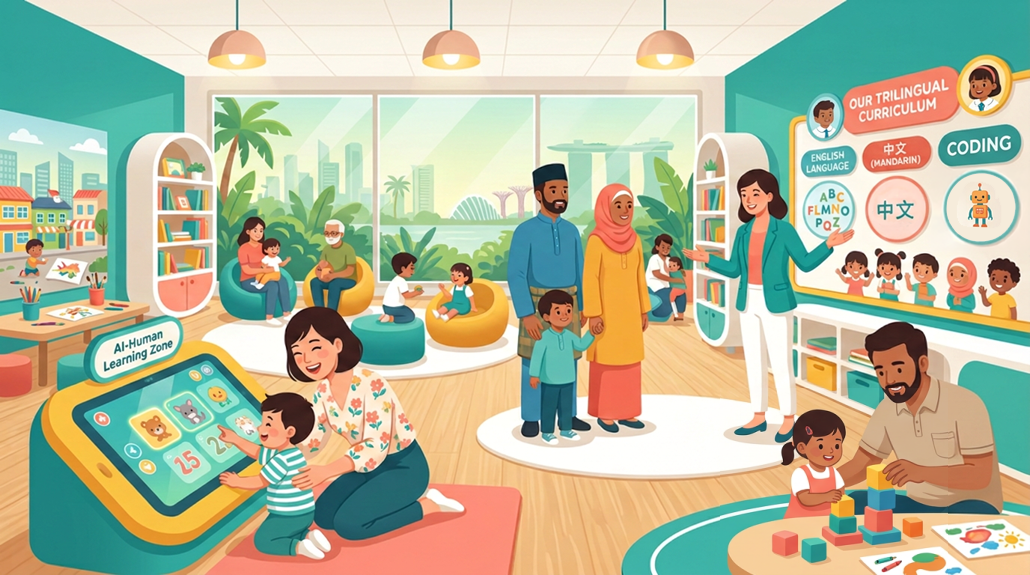
At ChildFirst, an open house is designed to be genuinely informative rather than a sales presentation. Parents are welcomed into our learning spaces at our Hillview and Tampines centres to see first-hand how our unique three-pronged curriculum comes to life across every age group, from 18 months through to Kindergarten 2.
Our curriculum integrates three distinct and complementary pillars. Our Artificial Intelligence curriculum introduces children to AI concepts and tools in age-appropriate, hands-on ways, preparing them to understand and work alongside technology rather than simply consume it. Our Human Intelligence curriculum nurtures the creativity, empathy, collaboration, and communication skills that remain distinctly human and irreplaceable, no matter how advanced technology becomes. Our Multiple Intelligences curriculum, inspired by Howard Gardner’s framework, helps each child discover their own unique strengths and learning profile, so that education is personalising rather than one-size-fits-all.
Trilingual learning is woven throughout every stage of the ChildFirst experience. Children develop confident proficiency in English alongside Chinese, with Coding as the third language – a structured, creative mode of thinking and communication that equips them with skills increasingly valued in a digital world. Our Ednoland curriculum technology and EdnoAI applications create a learning environment that is both innovative and deeply child-centred.
During an open house at ChildFirst, our educators are happy to walk you through specific examples from the classroom, answer your questions about how we track each child’s individual progress, and explain what makes our approach different from a conventional pre-school curriculum. Both our centres are SPARK-certified and Healthy Pre-school accredited, reflecting our commitment to quality and child wellbeing at every level. We have been recognised as the “Best in Trilingualism Pre-school” winner since 2020, a distinction we hold because of the depth and consistency with which we deliver trilingual learning across every part of the school day.
Every Visit Brings You Closer to the Right Choice
A pre-school open house is one of the most useful tools available to any parent navigating early childhood education in Singapore. When you arrive prepared, observe with intention, and ask the questions that matter most to your family, you move from feeling overwhelmed by choice to feeling genuinely informed. No two children are alike, and no two pre-schools are alike either. The best fit is the one where your child’s curiosity is met with warmth, where the curriculum is thoughtfully designed to nurture real capability, and where you as a parent feel genuinely welcomed as a partner in your child’s learning journey.
Trust the process, trust your child, and trust your instincts. The right environment makes all the difference.
Ready to See ChildFirst for Yourself?
Come and experience our trilingual AI + HI + MI curriculum first-hand at our Hillview or Tampines centre. Our educators will be delighted to show you around, answer every question on your list, and introduce you to the ChildFirst approach to future-ready learning.