Robotics for Pre-schoolers: Age-Appropriate STEM Activities in Singapore
Robotics for Pre-schoolers: Age-Appropriate STEM Activities in Singapore
If you have ever watched a three-year-old figure out how a toy car moves, or seen a four-year-old instinctively sort blocks by size and then try to build a ramp, you have already witnessed early engineering thinking in action. Robotics for preschoolers is not about turning toddlers into programmers. It is about giving very young children the language, confidence, and curiosity to understand the world that technology is shaping around them — and it starts much earlier than most Singapore parents realise.
Singapore’s education landscape is evolving rapidly. From coding electives in primary schools to AI literacy initiatives across the curriculum, children are being asked to engage with technology younger and more deeply than any previous generation. Pre-schools that integrate STEM thinking from the earliest years are giving children a meaningful head start, not just in technical skills but in the habits of mind that make technology meaningful: problem-solving, persistence, creative thinking, and collaboration.
This guide explains why robotics and STEM activities belong in the pre-school years, what age-appropriate engagement actually looks like from 18 months through kindergarten, and how Singapore families can support this learning both at a quality pre-school and at home.
Why Robotics Belongs in the Pre-school Years
There is a common assumption that robotics and coding are subjects for older children, reserved for primary school computing classes or weekend enrichment programmes. Research in early childhood development tells a different story. The years from birth to age six represent the most rapid period of brain development in a human lifetime, and the cognitive structures children build during this window, including spatial reasoning, cause-and-effect thinking, and sequential logic, are precisely the foundations that underpin computational thinking later on.
Introducing robotics concepts at the pre-school stage does not mean sitting a two-year-old in front of a screen. It means designing play experiences that develop the same cognitive muscles: block construction that requires planning ahead, simple sequencing games that mirror the logic of an instruction set, and guided exploration of cause and effect through toys and tools that respond to a child’s actions. When these experiences are intentional and developmentally calibrated, they build genuine readiness for the more formal STEM learning that follows in primary school and beyond.
Singapore’s Smart Nation initiative and the national emphasis on AI literacy make this foundation especially relevant. Children who grow up comfortable asking “why does this work?” and “what happens if I change this?” are far better positioned to thrive in an economy that is being reshaped by automation and artificial intelligence. Pre-school is not too early to begin that conversation.
What Age Can Children Start? A Developmental Guide
Understanding what is developmentally appropriate at each stage prevents frustration for both parents and children. Robotics learning for preschoolers moves through a clear progression that respects where children are cognitively and physically, not just chronologically.
18 Months to 2 Years: Cause and Effect
At this stage, children are scientists in the most literal sense. They drop objects repeatedly to observe what happens. They push buttons to hear sounds. They stack and knock down towers. The most appropriate STEM foundation here is rich sensory play, responsive toys that react to touch or movement, and simple cause-and-effect exploration. A pop-up toy or a wind-up animal is, developmentally speaking, a child’s first encounter with the idea that a specific action produces a predictable outcome: the core logic behind all programming.
Ages 3 to 4: Sequencing and Simple Construction
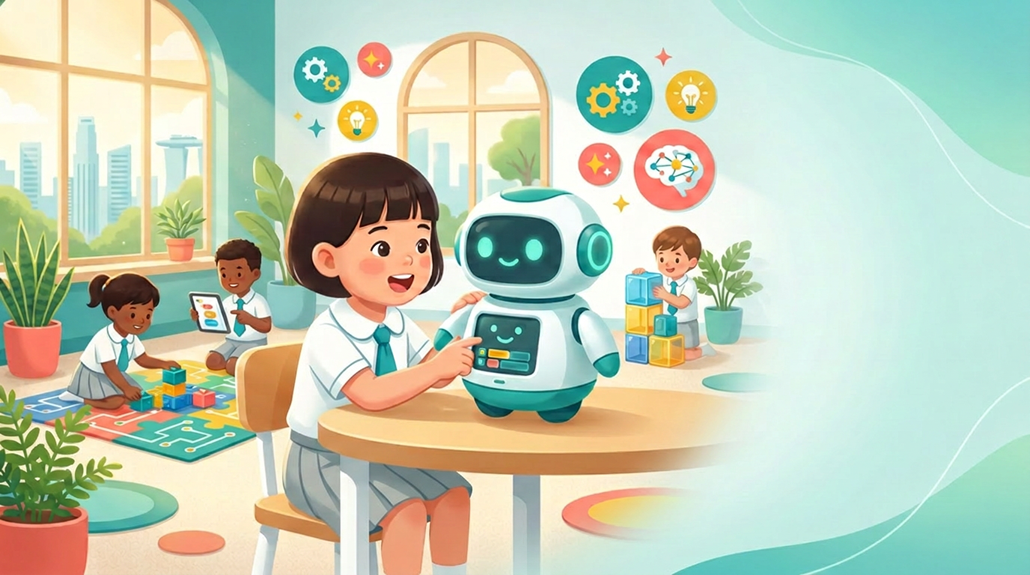
Between ages three and four, children develop the working memory needed to follow multi-step instructions and begin to think about order: what comes first, what comes next. This is the ideal time for simple construction sets, directional movement games, and guided storytelling where events happen in a logical sequence. Activities like programming a small floor robot by pressing directional arrows, or building a simple LEGO structure by following a visual plan, feel like play but are developing sequencing skills, spatial awareness, and the beginning of algorithmic thinking.
Ages 5 to 6: Problem-Solving and Iteration
By kindergarten age, children are ready for the full engineering cycle in miniature: plan, build, test, and improve. They can work collaboratively on a shared design challenge, tolerate failure and try again, and begin to articulate why something did not work. At this stage, age-appropriate robotics kits, block-based visual coding tools, and structured STEM challenges become genuinely powerful. The experience of debugging: figuring out why the robot turned the wrong way and correcting it, develops metacognitive habits that benefit every subject area, not just technology.
Age-Appropriate Robotics and STEM Activities for Pre-schoolers
The best STEM activities for preschoolers look nothing like the coding competitions you see at secondary school level. They are hands-on, playful, and embedded in familiar contexts. Here are activities that work well across the pre-school age range:
- Floor robot navigation. Simple programmable floor robots, designed for ages 3 and up, allow children to press directional buttons and watch the robot follow their instructions. The immediate visual feedback makes cause-and-effect thinking concrete and satisfying.
- Construction challenges with LEGO or Duplo. Open-ended and guided building challenges develop spatial reasoning, planning, and fine motor skills simultaneously. Adding a simple brief (“build something that can hold a small toy without falling”) introduces engineering thinking naturally.
- Pattern and sequencing games. Begin a simple pattern for your child to continue the sequence: red, blue, red, blue; big, small, big, small; circle, circle, triangle. Pattern recognition is the precursor to understanding loops in code and data structures in later learning.
- Unplugged coding activities. Games like Robot Turtles or human-robot play, where one child acts as the “robot” and follows instructions given by another, teach directional language and logical sequencing without any screen time at all.
- Block-based visual coding. For children aged five and above, simplified visual coding platforms use drag-and-drop blocks rather than text, making programming logic accessible without requiring reading skills. These tools bridge play and formal coding in a developmentally respectful way.
- Ramp and pulley exploration. Simple machines, ramps, levers, and pulleys introduce physics concepts and engineering reasoning. Asking children to predict what will happen before they test, and to explain what they observed afterwards, builds scientific thinking habits.
The key in all of these activities is the adult’s role: asking open questions rather than providing answers. Saying “Oh, that didn’t work, let’s figure out why!” teaches children that failure is a useful data point, not a verdict. This mindset is foundational to both STEM thinking and lifelong learning confidence.
The Skills Robotics Builds Beyond Technology
One of the most important things to understand about robotics and STEM activities for preschoolers is that the technology itself is almost incidental. The real value lies in the broader skills these activities develop: skills that no algorithm can replicate, and that children will need regardless of what careers await them.
Problem-Solving
Children learn to break a challenge into smaller steps and work through it systematically: a skill transferable to mathematics, language learning, and social challenges alike.
Creativity and Design Thinking
Designing a structure or programming a path requires children to imagine something that does not yet exist: the same creative muscle that drives art, storytelling, and innovation.
Resilience and Persistence
When a robot goes the wrong way, children must try again. Robotics normalises iteration and teaches children that effort and adjustment: not innate talent – produce results.
Communication and Collaboration
Group STEM challenges require children to negotiate, explain their reasoning, and listen to others: precisely the Human Intelligence skills that remain irreplaceable in an AI-integrated world.
These capabilities sit at the heart of what ChildFirst calls Human Intelligence (HI): the distinctly human qualities of empathy, creativity, communication, and adaptability that complement AI competencies rather than competing with them. The goal of early STEM education is not to produce child engineers. It is to grow capable, curious, resilient human beings who are ready to work alongside and direct the technologies of their future.
How ChildFirst Integrates Robotics into Trilingual Learning
At ChildFirst, robotics and computational thinking are not bolt-on enrichment. They are woven into a curriculum that views coding as the third language alongside English and Mandarin, ensuring that technology literacy develops in genuine context from the very beginning of a child’s learning journey.
Our approach is structured around three interconnected pillars. The Artificial Intelligence (AI) curriculum introduces children to computational thinking, digital tools, and the logic of how technology works, beginning at a level appropriate to each child’s developmental stage. The Human Intelligence (HI) curriculum develops the creativity, empathy, critical thinking, and communication skills that make technology meaningful and that no algorithm can replace, and the Multiple Intelligences (MI) curriculum, grounded in Howard Gardner’s framework, ensures that every child’s unique strengths: whether Logical-Mathematical, Bodily-Kinesthetic, Spatial, or Naturalist, are recognised, nurtured, and leveraged as entry points into STEM learning.
This three-pillar model means a child who is highly Bodily-Kinesthetic might first engage with sequencing concepts through physical movement activities before transitioning to a floor robot. A child with strong Spatial intelligence might be naturally drawn into construction challenges that then connect to programming logic. By meeting each child where their strengths already are, ChildFirst makes STEM learning genuinely inclusive rather than artificially uniform.
Our EdnoLand curriculum technology and EdnoAI applications create a personalised learning environment that adapts to each child’s pace and profile, giving educators rich data to support every learner while keeping the classroom experience warm, playful, and child-centred. Coding meets trilingual learning at ChildFirst in a way that feels natural rather than supplementary, because from the start, language and technology are taught as equally important tools for making sense of and contributing to the world.
Simple Robotics and Coding Activities to Try at Home
Pre-school STEM learning is most powerful when it is reinforced at home, but this does not require expensive kits or specialist knowledge. Some of the most effective activities use everyday materials and cost almost nothing.
- The Human Robot Game. Take turns being the robot and the programmer. The “programmer” gives single-step instructions (“step forward”, “turn left”, “stop”) and the “robot” follows them precisely. When the robot does exactly what was said, even if it leads to a funny result, it teaches children that instructions must be precise and unambiguous – a core programming concept.
- Recipe following as coding practice. Walk through a simple recipe together, treating each step as an instruction in a sequence. Ask your child what would happen if you skipped a step or did them in the wrong order. This makes algorithmic thinking feel relevant and real.
- Build-and-test engineering challenges. Use cardboard, tape, straws, and craft materials to set a simple challenge: build the tallest tower, build a bridge that can hold a toy car, or design a container that can carry five marbles. The materials cost very little; the thinking they prompt is genuinely sophisticated.
- Sorting and classifying games. Sorting objects by colour, size, shape, or material is data classification in its most accessible form. Add a simple rule (“put all the red ones here, everything else there”) and you are introducing Boolean logic without any jargon at all.
- Board games with logical structure. Games like Snakes and Ladders and Code Master develop sequential thinking, strategy, and the understanding that actions have consequences. For children approaching kindergarten age, these games extend naturally into conversations about planning and prediction.
The most important ingredient in all of these is your engagement as a parent. Children who see adults approach problems with curiosity and persistence, rather than frustration or avoidance, absorb those habits naturally. You do not need to know how to code to raise a child who is comfortable with technology. You simply need to be willing to wonder alongside them.
Choosing the Right Pre-school for STEM in Singapore
With so many enrichment programmes and pre-school options available in Singapore, it can be difficult to know what genuine STEM integration looks like versus surface-level exposure. When evaluating a pre-school’s approach to robotics and technology, consider asking the following questions:
- Is technology integrated into the curriculum or offered as a separate add-on? Integrated approaches build meaningful connections; standalone sessions can feel disconnected from the rest of learning.
- How does the programme balance screen time with hands-on, physical learning? Developmentally sound STEM education for preschoolers relies heavily on physical, manipulative experiences, not just digital tools.
- Does the school recognise and build on each child’s individual strengths? A one-size-fits-all STEM programme misses the point. Look for approaches that acknowledge different learning profiles and meet children where they are.
- Are both technical thinking and human skills valued equally? The best early STEM education develops creativity, communication, and resilience alongside computational thinking, because both sets of skills will matter enormously in the children’s futures.
ChildFirst’s SPARK-certified centres at Hillview and Tampines are designed with all of these principles in mind. Both English proficiency and Mandarin immersion are developed alongside coding literacy, giving children the full trilingual advantage in an environment that takes their individual Multiple Intelligences seriously from day one.
Raising Children Who Are Ready for What Comes Next
The children starting pre-school today will enter the workforce in a world shaped by artificial intelligence, automation, and technologies we cannot yet fully anticipate. What we can do is ensure they arrive at that future well-equipped: with the logical thinking to understand technology, the creativity and empathy to use it wisely, and the resilience to keep learning when things change.
Robotics and STEM activities for pre-schoolers are not a luxury or an accelerated programme for academically advanced children. They are a developmentally appropriate way of nurturing the whole child at the moment when nurturing matters most. The most powerful thing about starting early is not that children learn more facts. It is that they develop a relationship with learning itself: one characterised by curiosity, confidence, and the unshakeable belief that figuring things out is always worth the effort.
The foundations you build in these early years do not just prepare your child for primary school. They prepare them for everything that follows.
Want to See How We Bring Coding and Creativity Together for Your Child?
At ChildFirst, our AI + HI + MI trilingual curriculum begins from 18 months – integrating robotics, coding, and language learning in one seamless, joyful experience. Come and see it for yourself at our Hillview or Tampines centre.
ChildFirst • Trilingual AI + HI + MI Curriculum • Singapore Pre-school.