The Future-Ready Child: Why Coding and AI Literacy Matter from Age 3
The Future-Ready Child: Why Coding and AI Literacy Matter from Age 3
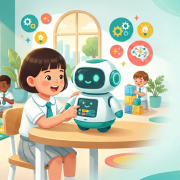
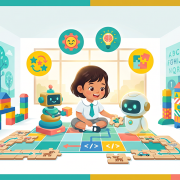
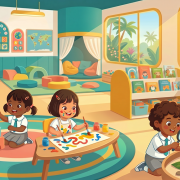
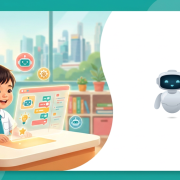
Picture a five-year-old confidently directing a small robot across a mat, adjusting her instructions when it veers off course, and explaining to her friend, “It only does what I tell it. I have to be precise.” She is not a prodigy. She has simply grown up in an environment where computational thinking and creative problem-solving are treated as natural parts of learning – woven into storytime, art, and outdoor play just as naturally as counting or singing.
That scene is no longer a vision of a distant future. It is already unfolding in pre-schools that have made AI literacy and coding central to early childhood education. And the research on why this matters is compelling: the early years, from birth through age six, represent the most rapid period of brain development in a human lifetime. What children learn to think about, and how they learn to think, during these years shapes the cognitive habits they carry into adulthood.
This article explores the developmental case for starting coding and AI literacy at age three, what that actually looks like in practice, and why the schools that get this right are not simply teaching children to use technology – they are teaching children to think. Along the way, you will see how ChildFirst’s unique approach, grounded in a trilingual curriculum that integrates Artificial Intelligence, Human Intelligence, and Multiple Intelligences, puts Singapore children in a genuinely strong position for the world ahead.
The Window That Cannot Wait
Developmental scientists have long documented what parents observe instinctively: young children are extraordinary learners. Between birth and age five, a child’s brain forms roughly one million new neural connections every second. Language, emotional regulation, spatial reasoning, and early mathematical thinking all take root during this period, and the quality of experiences a child has in these years has a measurable, lasting impact on learning outcomes well into adulthood.
Economist James Heckman‘s decades of research consistently show that high-quality early learning programmes yield returns of up to 13% per year – returns measured not only in academic performance – but in health, civic participation, and economic productivity. The implication for AI and coding literacy is straightforward: if these skills matter for the future, the optimal time to begin building their foundations is not primary school. It is now.
Today’s toddlers are already navigating an AI-saturated world. They interact with voice assistants, watch recommendation engines curate their videos, and follow GPS-guided journeys. The question is not whether they will encounter AI – they already have. The question is whether they will grow up understanding it well enough to use it wisely, critically, and creatively, or whether they will simply be shaped by it without knowing it.
“The foundational skills that matter most in a post-AI world: creativity, critical thinking, empathy, resilience, start to take root long before formal schooling begins.”
What AI Literacy Actually Means for a Three-Year-Old
When parents hear “AI literacy at age three”, many picture children hunched over tablets or staring at screens. That image is almost entirely wrong. Early AI literacy is not about software. It is about the habits of mind that allow a person, child or adult, to interact with intelligent systems thoughtfully rather than passively.
At the pre-school level, AI literacy looks like asking simple but profound questions during play: What can this thing do? What can it not do? Why did it make a mistake? How do I give it better instructions? These questions, introduced through games, storytelling, and hands-on activities, plant the seeds of computational thinking: the ability to break a problem into steps, recognise patterns, and evaluate outcomes systematically.
Young children are also naturally inclined to anthropomorphise technology, treating robots and voice assistants as social beings with feelings and intentions. Without guidance, this tendency can lead to an uncritical trust in machines. With thoughtful early education, it becomes a springboard for nuanced conversations about what makes humans unique: conversations that build both digital fluency and emotional intelligence simultaneously.
Coding as the Third Language
ChildFirst’s trilingual curriculum treats English, Chinese, and Coding as three parallel languages: each a distinct system for expressing ideas, solving problems, and communicating with the world. This framing is deliberate and developmentally sound. Language acquisition research shows that young children’s brains are uniquely primed for language learning: they absorb grammatical structures, vocabulary, and the logic of a new system with an ease that diminishes significantly after the primary school years.
Coding, at its core, is a language. It has syntax (rules of structure), vocabulary (commands and functions), and grammar (the logic that links them). When children learn to code early: through sequences, conditionals, and loops introduced playfully through blocks, stories, and physical activity, they are not simply learning a technical skill. They are developing a new cognitive mode: the ability to think in precise, logical sequences while remaining creative about the problems they choose to solve.
At ChildFirst, this is realised through the Coding Meets Trilingual Learning dimension of the curriculum, where coding concepts are introduced in age-appropriate ways that connect to children’s existing interests and multilingual development. A child working through a sequencing activity in English can reinforce the same logical structure in Mandarin, and then apply it to a coding challenge, creating a powerful web of connected understanding.
Why Start Coding Before Age Six?
- Language window. The brain’s peak sensitivity for absorbing new language systems, including coding logic, is concentrated in the early years.
- Pattern recognition. Young children are natural pattern-seekers; coding activities build directly on this cognitive strength.
- Resilience through debugging. Learning that errors are information, not failures, cultivates a growth mindset that benefits every area of life.
- Creative confidence. Children who can give instructions to a machine discover early that they are makers and designers, not just consumers of technology.
- Transferable logic. Sequencing, conditionals, and decomposition skills transfer directly to mathematics, reading comprehension, and scientific thinking.
The Human Skills That AI Cannot Replace
Here is the paradox at the heart of early AI education: the more capable AI becomes, the more valuable genuinely human qualities become. Creativity that connects unexpected ideas. Empathy that reads a room. Ethical judgement that weighs competing values. Leadership that inspires trust. These are not soft skills in any dismissive sense of the word – they are the competencies that define irreplaceable human contribution, and they are built in childhood.
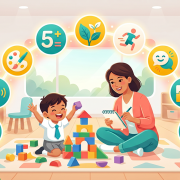
This is why the best early AI literacy programmes do not replace play, art, music, storytelling, or outdoor exploration with screen time. They integrate technology awareness into a rich, developmentally holistic environment. Children who spend their pre-school years developing deep human capacities: through dramatic play, collaborative problem-solving, exposure to multiple languages, and creative expression, are not falling behind technologically. They are building the very foundation that will make them exceptional users and shapers of AI.
ChildFirst’s Human Intelligence curriculum is designed precisely around this insight. It nurtures the capacities that distinguish human thinking from machine processing: empathy, ethical reasoning, communication, self-regulation, and the kind of intuitive creativity that no algorithm has yet come close to replicating.
A Three-Pronged Framework: AI, HI, and MI
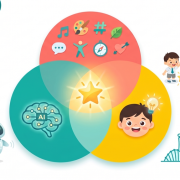
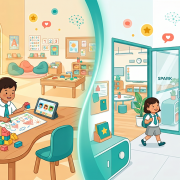
What makes ChildFirst’s approach distinctive is that it refuses to treat AI literacy and human development as competing priorities. Instead, the curriculum integrates three pillars into a coherent whole, recognising that each strengthens the others.
Artificial Intelligence
Coding, computational thinking, and age-appropriate AI awareness through the AI curriculum.
Human Intelligence
Creativity, empathy, communication, and the irreplaceable qualities that define human contribution. Explore the HI curriculum.
Multiple Intelligences
Recognising each child’s unique strength profile: Linguistic, Logical-Mathematical, Bodily-Kinesthetic, Naturalist, and more. See the MI curriculum.
The Multiple Intelligences dimension is particularly important because it guards against a one-size-fits-all approach to AI readiness. A child who is highly Bodily-Kinesthetic may engage with coding concepts most deeply through physical robotics and movement-based activities. A child who is strongly Linguistic may first connect with computational thinking through storytelling and narrative sequencing. By recognising that every child has a unique intelligence profile, the curriculum ensures that AI and coding literacy are made genuinely accessible, not just to the children who already gravitate toward logical-mathematical thinking.
Underpinning all three pillars is ChildFirst’s EdnoLand curriculum technology and EdnoAI applications, which deliver personalised learning experiences that adapt to each child’s developmental stage and engagement pattern: freeing educators to focus on the human interactions that no technology can substitute.
The trilingual dimension adds another layer of depth. Children at ChildFirst develop English proficiency and Mandarin fluency alongside Coding as the third language, creating a cognitive profile that is genuinely exceptional. Research on multilingualism consistently shows that children who operate across multiple language systems develop enhanced executive function, cognitive flexibility, and the ability to hold competing perspectives, all of which are precisely the human capacities most complementary to working intelligently alongside AI.
What Parents Can Do at Home
Parents often ask how they can support coding and AI literacy at home without formal training or expensive equipment. The honest answer is that the most powerful thing any parent can do costs nothing: narrate the technology around you, and ask questions out loud.
When the GPS recalculates, ask your child, “How do you think it knew we made a wrong turn?” When a video recommendation appears, wonder aloud, “I wonder how it decided to show us that one.” When a voice assistant misunderstands a question, say, “Oh, it got confused, what do you think would have been a clearer way to ask?” These micro-conversations, repeated across hundreds of ordinary moments, build the questioning habit that is the foundation of genuine AI literacy.
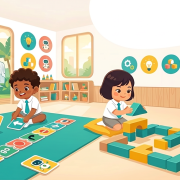
Beyond conversation, unplugged coding activities are remarkably effective for young children. Sequencing games – where you give a series of instructions to direct a toy, a sibling, or even yourself across the room – introduce the core logic of programming without a screen in sight. Board games such as Robot Turtles and Code Master make this even more engaging. Pattern activities work beautifully too: begin a simple pattern for your child to continue the sequence: red, blue, red, blue; big, small, big, small; circle, circle, triangle. Pattern recognition is the cognitive engine underneath both coding and mathematics, and children take to it naturally when it is introduced as play.
Choosing the Right Pre-school Environment
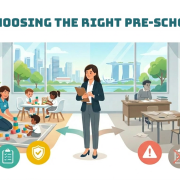
For Singapore parents navigating the Pre-school landscape, the proliferation of technology-themed programmes can make it difficult to distinguish genuine early AI education from marketing language wrapped around screen time. A few questions are worth asking of any pre-school that claims to offer coding or AI literacy.
- Is the programme designed for the developmental stage? Coding and AI concepts should be introduced through play, movement, and concrete materials, not through abstract screen-based instruction.
- Does the programme balance technology with human development? A curriculum that offers AI exposure but neglects creativity, empathy, and communication is not future-ready, it is one-dimensional.
- Are educators trained to facilitate these conversations, not just manage the tools? The quality of teacher facilitation matters far more than the sophistication of the technology in the room.
- Does the programme recognise individual differences? Every child has a different intelligence profile. A genuinely good programme meets children where they are, rather than expecting every child to connect with technology in the same way.
ChildFirst, operating across its Hillview and Tampines locations, was designed with all of these questions in mind. As a SPARK-certified and Healthy Pre-school accredited institution, and a consistent winner of the “Best in Trilingualism Pre-School” award since 2020, ChildFirst brings together decades of educational technology expertise: rooted in Ednovation’s pioneering work in Singapore since 1991, with a curriculum that is genuinely integrative rather than superficially tech-themed.
The result is an environment where a three-year-old can encounter coding as a natural extension of storytelling, where a five-year-old can discuss what a robot can and cannot understand, and where every child, regardless of their particular intelligence profile, is seen, stretched, and celebrated. That is what future-readiness actually looks like in the early years.
The Bottom Line
The case for coding and AI literacy beginning at age three is not about accelerating childhood or replacing play with programming. It is about recognising that the habits of mind children form in their earliest years: curiosity, precision, resilience in the face of errors, empathy, creative confidence, are exactly the habits that will allow them to thrive in a world increasingly shaped by intelligent machines.
AI is not arriving. It has already arrived, and it is already part of your child’s daily experience. The question every parent faces is whether that experience will be one of passive consumption or active, thoughtful engagement. The answer begins not in primary school, not at a secondary school robotics club, but now, in the pre-school years, when the brain is most alive to new ways of thinking, and when the foundations of a genuinely future-ready mind are laid.
Start early, start thoughtfully, and trust the extraordinary capacity of your young child to rise to the moment.
ChildFirst • Trilingual AI + HI + MI Curriculum • Singapore Pre-school.
Want to See How We Bring Coding, AI, and Creativity Together for Your Child?
Join us for a school tour at ChildFirst and experience our award-winning trilingual curriculum first-hand. Our educators will walk you through how we integrate Artificial Intelligence, Human Intelligence, and Multiple Intelligences to help every child discover and develop their unique strengths – from 18 months through kindergarten.