MI + AI + HI: How ChildFirst Combines Multiple Intelligences with Technology
Picture two children sitting side by side in a pre-school classroom. One lights up the moment music starts; the other is happiest pulling apart a puzzle and rebuilding it from scratch. Both are brilliant. Both deserve a learning environment that sees that brilliance and builds on it, while also preparing them for a world where artificial intelligence is already reshaping every career and every industry.
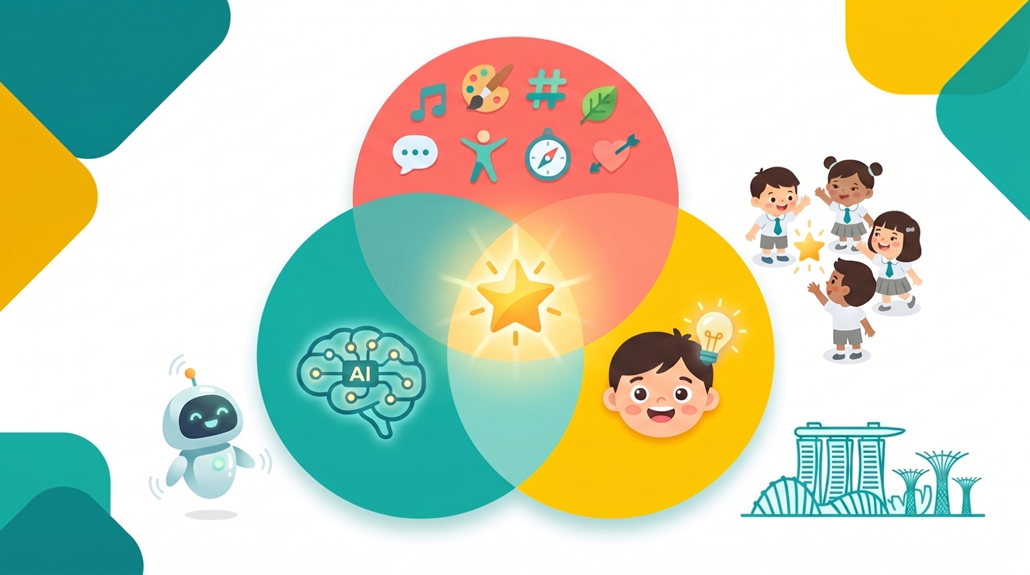
At ChildFirst, that is not an aspiration, it is the curriculum design. The pre-school’s signature three-pronged framework weaves together Multiple Intelligences (MI), Artificial Intelligence (AI), and Human Intelligence (HI) into a single, coherent learning journey. Add a trilingual immersion in English, Chinese, and Coding, and you have an approach that is genuinely unlike anything else available in Singapore’s early childhood landscape. This article unpacks each pillar of the framework, explains how they interact in daily learning, and shows why the combination gives children a meaningful head start for the decades ahead.
Why Three Intelligences? The Thinking Behind the Framework
Most early childhood programmes focus on one dimension of learning: either academic readiness, social-emotional growth, or, more recently, digital literacy. ChildFirst, founded by Dr. Richard Yen and backed by Ednovation’s three decades of educational technology expertise, took a different view. The premise is straightforward: the children entering pre-school today will graduate into a workforce that is co-created by humans and machines. Preparing them for that future means developing three distinct but interlocking capabilities simultaneously.
First, every child arrives with a unique intelligence profile — a personal constellation of strengths that a rigid, one-size-fits-all syllabus will never fully activate. Second, AI tools are already embedded in everyday life, and children who learn to work alongside them early will be far more confident navigating them later. Third, there are deeply human capacities: empathy, creativity, ethical reasoning, collaboration, that no algorithm can replicate, and those capacities need deliberate cultivation from the earliest years. The MI + AI + HI framework is designed to address all three at once, within a trilingual environment that adds a further cognitive advantage.
Multiple Intelligences: Every Child Is Smart in a Different Way
The MI pillar draws on Howard Gardner’s theory of Multiple Intelligences, which proposes that human intelligence is not a single, measurable quantity but a spectrum of distinct abilities. Gardner identified eight intelligences: Linguistic, Logical-Mathematical, Spatial, Bodily-Kinesthetic, Musical, Interpersonal, Intrapersonal, and Naturalist. Every child has all eight in varying degrees, and the combinations are as individual as a fingerprint.
At ChildFirst, the Multiple Intelligences curriculum is designed to surface each child’s strongest intelligences early, and then use those strengths as entry points for broader learning. A child who is highly Bodily-Kinesthetic, for example, does not just get extra movement breaks. They encounter number concepts through physical sequencing activities, and they build Linguistic skills through dramatisation and role play. A child who is naturally Naturalist investigates patterns in the natural world and gradually transfers that pattern-recognition to Logical-Mathematical reasoning.
The practical implication for parents is significant. Rather than comparing their child to a standardised developmental chart, they receive insight into their child’s individual intelligence profile. That information shapes how teachers design activities, how they group children for collaborative projects, and how they communicate progress. The goal is for every child to leave ChildFirst knowing how they are smart, not just whether they are smart.
Gardner’s Eight Intelligences at a Glance
Linguistic
Strength in words, stories, and language.
Logical-Mathematical
Strength in patterns, numbers, and reasoning.
Spatial
Strength in images, design, and visual thinking.
Bodily-Kinesthetic
Strength in movement, coordination, and hands-on making.
Musical
Strength in rhythm, melody, and sound.
Interpersonal
Strength in understanding and connecting with others.
Intrapersonal
Strength in self-awareness, reflection, and inner motivation.
Naturalist
Strength in recognising patterns in the natural world.
ChildFirst • Trilingual AI + HI + MI Curriculum • Singapore Pre-school.
Artificial Intelligence: Learning with Technology from Day One
The word “artificial intelligence” can sound abstract, even intimidating, in the context of a pre-school. At ChildFirst, it is neither. The AI curriculum is designed to make technology a familiar, useful, and joyful presence in a child’s learning from as early as 18 months. The aim is not to produce miniature programmers, it is to build a generation of children who are comfortable directing, questioning, and evaluating AI tools rather than being passively shaped by them.
In practical terms, this means children engage with age-appropriate AI-powered activities that respond to their choices, adapt to their pace, and provide immediate feedback. A toddler might use an interactive storytelling application that generates a new narrative branch when they choose a character’s next action. A kindergarten child might explore a simple visual AI that identifies objects and sorts them by category, prompting the question: “How does the computer know?” That question: curiosity about how intelligent systems work is precisely the disposition ChildFirst wants to cultivate.
It is worth noting what the AI pillar is not. Technology at ChildFirst is never a replacement for the teacher-child relationship or for hands-on, embodied play. Screens and AI tools occupy a defined, purposeful portion of the day, and they are always framed by a skilled educator who contextualises what the technology is doing and why. This deliberate balance is what separates genuine AI integration from simply putting tablets in classrooms.
Human Intelligence: Nurturing What Technology Cannot Replace
If the AI pillar prepares children to work with machines, the HI pillar safeguards what makes them irreplaceably human. ChildFirst’s Human Intelligence curriculum focuses on the capacities that even the most sophisticated AI cannot authentically replicate: creativity, empathy, ethical thinking, resilience, and the ability to collaborate with nuance and cultural sensitivity.
These are not soft skills in the dismissive sense of the phrase. They are, increasingly, the skills that employers across every sector identify as hardest to find and most valuable to retain. A child who learns, from the age of three, to take a peer’s perspective, to persist through a difficult creative challenge, or to notice when a group decision feels unfair, that child is building professional and civic capabilities that will serve them for life. In the ChildFirst classroom, HI development happens through structured collaborative projects, open-ended creative play, reflective conversations with teachers, and community-oriented learning experiences that extend beyond the centre itself.
The interplay between HI and MI is particularly rich. Understanding your own intelligence profile (an Intrapersonal strength) directly supports the kind of self-directed learning that HI development requires. A child who knows they are highly Musical, for instance, can channel that strength into collaborative storytelling, using rhythm and melody to help the group remember a narrative sequence. The two pillars reinforce each other in ways that a siloed curriculum simply cannot achieve.
The Trilingual Thread That Ties It All Together
Language is not a separate subject at ChildFirst, it is the medium through which MI, AI, and HI are all experienced. The trilingual environment immerses children in English, Chinese, and Coding as a third language simultaneously, from their earliest days at the pre-school. Research consistently shows that early multilingual exposure strengthens cognitive flexibility, working memory, and the ability to switch between conceptual frameworks, all of which are directly relevant to the kind of adaptive thinking the MI + AI + HI framework is designed to develop.
English proficiency is developed through rich literary experiences, structured storytelling, and purposeful communication activities that draw on Linguistic and Interpersonal intelligences. Chinese learning is embedded across the curriculum rather than confined to a single lesson slot, so children encounter it in contexts that feel meaningful and lived-in. And Coding as a third language builds Logical-Mathematical reasoning through sequences, conditionals, and problem-solving, creating a direct bridge between the MI and AI pillars. Together, the three languages give children three distinct but complementary ways of making meaning in the world.
EdnoLand and EdnoAI Applications in Action
The technology infrastructure that supports the MI + AI + HI framework is purpose-built for early childhood. Our EdnoLand curriculum technology and EdnoAI applications create a learning environment where data and pedagogy work together rather than in competition. EdnoLand is not an off-the-shelf educational software suite – it was developed by Ednovation, ChildFirst’s parent company, specifically to support the kind of intelligence-differentiated, trilingual learning the pre-school delivers.
In practical terms, EdnoLand tracks each child’s engagement patterns across activities, flags emerging strengths, and surfaces insights that help teachers personalise their approach. EdnoAI applications provide the interactive, adaptive experiences children encounter directly, whether that is a language game that adjusts its vocabulary level in real time, a coding puzzle that offers a different hint depending on where a child gets stuck, or a creative composition tool that responds to a child’s musical choices. The result is a classroom environment where technology genuinely serves the child’s individual developmental journey, not just the curriculum calendar.
What a Day in the MI + AI + HI Classroom Looks Like
It helps to ground an abstract framework in a concrete picture. A morning at ChildFirst might begin with a circle-time conversation in Mandarin that draws on Interpersonal and Linguistic intelligences, asking children to share what they noticed on the way to school: a cloud shape, a construction site, a bird. From there, small groups move to different activity stations. One group uses an EdnoAI storytelling application to build an English narrative around the things they observed, choosing characters and plot turns with the guidance of a teacher who is noting which children are driving the story and which are listening carefully. Another group works on a Bodily-Kinesthetic coding activity, physically sequencing movement cards to direct a classroom robot along a mapped path.
Later in the morning, the whole class might reconvene for a collaborative art project with a problem-solving dimension: how do we make our mural look the same on both sides? The Spatial and Logical-Mathematical children often take a natural lead on symmetry, while the Interpersonal children negotiate how the group will divide the work. The teacher’s role throughout is to observe, question, and gently stretch each child just beyond their current comfort zone, a role that EdnoLand’s insights make far more targeted and informed. By the time children head to lunch, they have moved between English, Chinese, and Coding contexts, engaged with AI tools, exercised multiple intelligences, and practised thoroughly human skills of negotiation, creativity, and reflection.
ChildFirst at a Glance
2
Locations: Hillview and Tampines.
3
Languages: English, Chinese, and Coding.
18 months+
Age range: 18 months to 6 years.
Since 2020
“Best in Trilingualism Pre-school” award winner.
ChildFirst • Trilingual AI + HI + MI Curriculum • Singapore Pre-school.
The ChildFirst Difference for Singapore Families
Singapore parents are discerning. They want evidence, not promises, and they want a pre-school that can articulate not just what it does but why it does it. ChildFirst’s MI + AI + HI framework is grounded in established educational research, implemented through purpose-built technology, and delivered by educators who are trained to observe and respond to individual intelligence profiles. Both the Hillview and Tampines centres hold SPARK certification and Healthy Pre-school accreditation, providing independent verification of the quality standards that underpin the daily curriculum.
The recognition as “Best in Trilingualism Pre-school” winner since 2020 reflects something parents notice on the ground: children who are genuinely confident moving between languages and learning modalities, not children who have been drilled into compliance. That confidence comes from an environment where intelligence is understood broadly, technology is used purposefully, and humanity is celebrated deliberately. That is the ChildFirst difference, and it begins the moment a child walks through the door.
The MI + AI + HI framework is not three separate programmes bolted together. It is a single, coherent philosophy of what it means to educate a child well in the twenty-first century: see every child’s unique intelligence profile, equip them to work alongside technology with confidence, and deepen the human capacities that no machine will ever make redundant. Wrapped in a trilingual environment that builds cognitive flexibility from the earliest months, and delivered through the EdnoLand curriculum technology and EdnoAI applications that Ednovation has spent over thirty years developing, it is an approach that takes both the present and the future seriously.
Every child has a unique intelligence profile. The question is whether their pre-school is designed to find it, celebrate it, and build on it.
Want to See the MI + AI + HI Framework in Action?
Come and see how both our Hillview and Tampines centres bring Multiple Intelligences, Artificial Intelligence, and Human Intelligence together every single day. Our team would love to show you around and answer your questions.