Should You Choose a Pre-school Near Home or Near Your Workplace?
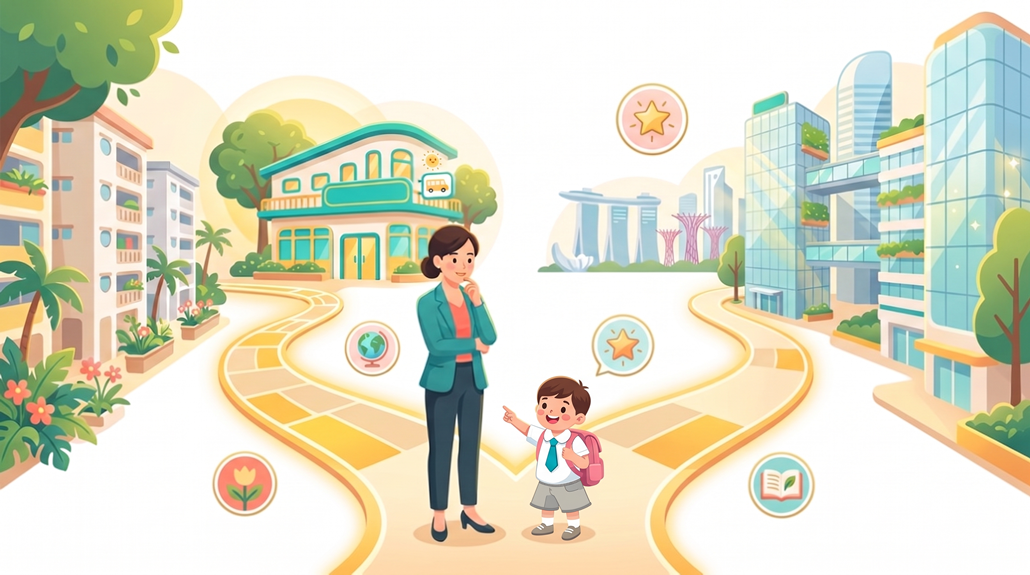
Choosing a pre-school is one of the most significant decisions you will make as a parent. And once you have narrowed down the shortlist by curriculum, reputation, and accreditation, a very practical question tends to surface: should the pre-school be close to where you live, or close to where you work?
There is no single right answer. The best choice depends on your family’s daily rhythms, your caregiving arrangements, your work schedule, and perhaps most importantly, the quality of education and environment the pre-school provides. This article walks through every factor worth considering, so you can make a decision that works for your child and your household, not just the map.
The Real Question Behind the Decision
Most parents frame this as a logistics question, and it certainly is that. But beneath the logistics is a deeper concern: how do we give our child the most consistent, settled, and enriching early childhood experience possible? The commute matters because a tired, hungry child arriving at school after a long journey is not a child ready to learn. Pick-up timing matters because a child waiting anxiously for a parent who is stuck in cross-island traffic has an entirely different emotional experience from one whose parent arrives in minutes.
Keep your child’s daily wellbeing at the centre of the decision, and the practical factors below will all fall into clearer focus.
Who Does the School Run?
The first thing to establish is who will be responsible for drop-offs and pick-ups on a typical day. In many Singapore households, this is a combination of parents, grandparents, a domestic helper, or a childminder. Each person’s situation changes what “convenient” actually means.
If a grandparent or helper handles the school run, a pre-school near home is almost always the practical choice. They are based at your home address, not your office, and navigating an unfamiliar part of the city adds unnecessary stress to what should be a simple morning routine. A walkable distance from home is even better, it removes the need to manage public transport or car parking with a young child in tow.
If both parents share the school run equally on alternating days, a centrally located pre-school or one close to home will again serve the whole family better than one tied to a single parent’s office. The school run should not create a bottleneck that falls entirely on one person’s shoulders.
Practical Tip:
Before committing to a pre-school location, map out a full week’s school-run schedule. Include every person who might drop off or collect your child, and trace their journey from their starting point, not yours.
Your Office Hours and Pick-Up Times
If you are the parent doing the afternoon pick-up and your office hours run close to the pre-school’s closing time, the case for a workplace-adjacent pre-school becomes much stronger. Leaving your desk at 6.30 pm and having to cross half of Singapore to reach a school that closes at 7 pm is a recipe for daily anxiety – for both you and your child.
A pre-school near your office means you can step out of work and be at the gate within minutes. On the days you finish later than expected, the difference between a five-minute walk and a forty-minute commute is enormous. It also means that in an emergency: an unexpected fever, a fall in the playground, a need for immediate reassurance, you are genuinely close by.
That said, consider what happens at the end of the day after pick-up. If the pre-school is near your office in the Central Business District (CBD) or a business hub, you still have the commute home ahead of you – now with a tired young child. That journey, taken at the peak-hour rush, can erode the quality time you hoped to have together in the evenings.
Flexible Work Arrangements and Who Shares the Load
Hybrid and remote work arrangements have become far more common in Singapore since 2020, and many parents now work from home on at least two or three days a week. If that describes your situation, your home address becomes a more reliable anchor point than your office, because it is the one location that stays constant regardless of your schedule.
Choosing a pre-school near home under hybrid working also distributes the school run more equitably between both parents. When a pre-school is anchored to one parent’s workplace, that parent shoulders the drop-off and pick-up responsibility by default, even on days when the other parent is at home and perfectly placed to help. A home-based location gives the whole household more flexibility.
If your work situation is stable, both parents consistently commuting to the same office five days a week for the foreseeable future, and your office is near each other, then a workplace-proximate pre-school becomes a genuinely practical option. The key word is stability. Pre-school enrolments typically span one to three years; if your workplace or schedule is likely to change within that window, a location tied to your current office may become inconvenient far sooner than expected.
Cost Differences and What You Get for the Fees
Pre-school fees in Singapore’s CBD and city-fringe areas are generally higher than those in residential heartland estates. This reflects the rental costs that operators pass on, and it is a legitimate factor when budgeting for early childhood education over several years.
Beyond fees, it is worth thinking about what the physical environment offers your child. Pre-schools housed in commercial buildings in the CBD often have more limited outdoor space, which matters for active play, nature exploration, and the kind of unstructured movement that young children need for healthy development. Pre-schools in residential areas frequently have more generous grounds, purpose-designed play facilities, and a neighbourhood feel that helps children develop a sense of belonging to a community.
This does not mean CBD pre-schools cannot offer excellent facilities, some invest significantly in creative indoor environments to compensate. But it is a dimension worth investigating before you make a decision based on location convenience alone.
Your Child’s Settling-In Experience
One consideration that parents often overlook in the home-vs-workplace debate is how location affects the settling-in period. Young children, especially those starting pre-school for the first time between 18 months and three years of age, build confidence partly through familiarity with the wider world around them.
When a pre-school is near home, children often encounter familiar elements on the journey: the park they visit on weekends, the kopitiam their grandparent stops at, the bus stop they recognise. These small anchors help the route to school feel safe and known, which eases separation anxiety and supports a smoother transition. The neighbourhood itself becomes an extended part of the child’s learning environment.
A pre-school near your workplace, by contrast, places your child in a part of the city that may feel entirely foreign and impersonal. For some resilient children this makes little difference; for others, especially those who need more time to feel settled, the unfamiliarity of the surroundings can quietly add to the adjustment challenge.
18 months+
Age from which settling-in is most sensitive to routine and familiar surroundings.
2–4 weeks
Typical settling-in window: consistency of routine and environment shortens this.
1–3 years
Typical enrolment span: long enough that workplace location changes will matter.
Curriculum Quality Should Anchor Your Decision
Location is a meaningful factor, but it should never override the quality of what happens inside the pre-school. The early years from 18 months to six years are a critical window for language acquisition, cognitive development, and the formation of learning habits that follow a child for life. A convenient location saves you thirty minutes a day; an excellent curriculum shapes your child’s relationship with learning for decades.
When evaluating curriculum, look beyond the marketing language and ask specific questions. How are children encouraged to think, not just recall? How does the pre-school approach trilingual learning — not as three separate language lessons, but as an integrated, immersive experience? How is your child’s individual learning style identified and nurtured rather than pushed into a one-size-fits-all mould?
At ChildFirst, our curriculum is designed around three interconnected pillars that prepare children not just for primary school, but for the world they will actually inhabit. Our Artificial Intelligence curriculum introduces children to computational thinking and AI concepts at an age-appropriate level, building familiarity with the technology that will define their future. Alongside this, our Human Intelligence curriculum nurtures the creativity, empathy, and collaboration skills that no algorithm can replicate. And our Multiple Intelligences curriculum ensures that every child – whatever their natural strengths – finds a way to shine.
Our trilingual model weaves English, Chinese, and Coding as a third language through everyday learning rather than treating them as three separate subjects. Delivered through our EdnoLand curriculum technology and EdnoAI applications, this approach creates a genuinely immersive environment where language and logic development happen together, naturally.
Quick Comparison: Home vs Workplace Location
The table below summarises the key trade-offs to help you think through your own situation clearly.
| Factor | Pre-school Near Home | Pre-school Near Workplace |
|---|---|---|
| School run flexibility | High: any caregiver can manage it | Low: tied to one parent’s commute |
| Late work days | Caregiver at home can cover pick-up | Parent nearby can collect quickly |
| Hybrid working | Works well: home is the constant | Problematic on WFH days |
| Fees | Typically lower in heartland areas | Often higher in commercial districts |
| Outdoor space | Usually more generous | Often limited in commercial buildings |
| Child’s settling-in | Familiar surroundings ease transition | Unfamiliar area may slow adjustment |
| Emergency response | Caregiver or nearby parent can respond | Working parent can respond quickly |
| Long-term stability | High: home address rarely changes | Lower: job or office location may change |
This table is a general guide. Individual family circumstances will vary. Infographic by ChildFirst • Trilingual AI + HI + MI Curriculum • Singapore Pre-school.
Finding the Right Fit for Your Family
For most Singapore families, a pre-school near home is the more sustainable and flexible choice, particularly when a caregiver is involved in the daily routine, work arrangements allow some flexibility, or parents commute in different directions. Home is the one constant in your child’s life, and a nearby pre-school often becomes a natural extension of your family’s community.
A pre-school near your workplace may be a better fit if you personally handle daily drop-offs and pick-ups, expect your office location to remain stable for the next two to three years, face a lengthy commute with a child, and typically finish work close to the pre-school’s closing time. In these circumstances, being close to your workplace can reduce logistical stress and make daily routines more manageable.
Whichever you choose, resist the temptation to let location become the primary filter. Visit the pre-schools on your list in person. Observe how teachers interact with children. Ask about the curriculum framework, the approach to language development, and how the school tracks each child’s individual progress. A pre-school fifteen minutes further away but with an exceptional programme will serve your child far better than the nearest option with an uninspiring one.
The right pre-school is the one where your child genuinely thrives, and that combination of the right environment, the right people, and the right curriculum is always worth the extra planning it takes to find.
Key Takeaways
- Who manages the school run is the most immediate practical question. If a grandparent or helper is involved, a home-adjacent pre-school is almost always more workable.
- Hybrid work arrangements tip the scales strongly towards a home-based location, because home is the one constant in your schedule.
- Your child’s settling-in experience benefits from familiar surroundings, something a neighbourhood pre-school naturally provides.
- Fees and facilities often favour heartland locations, with more outdoor space and generally lower costs.
- Curriculum quality should always anchor the decision. Location is a supporting factor, not the deciding one.
Ready to See ChildFirst for Yourself?
ChildFirst operates SPARK-certified, Healthy Pre-school accredited centres in Hillview and Tampines, each designed to deliver our unique trilingual AI + HI + MI curriculum in a warm, state-of-the-art environment. Whether home or workplace is closer, we welcome you to come and experience the difference in person.