What Are Multiple Intelligences? Howard Gardner’s Theory Explained for Parents
What Are Multiple Intelligences? Howard Gardner’s Theory Explained for Parents
Every Child Is Uniquely Intelligent.
Understanding Howard Gardner’s Multiple Intelligences theory is one of the most empowering things a parent can do.
ChildFirst • Trilingual AI + HI + MI Curriculum • Singapore Pre-school.
Have you ever watched your child spend forty minutes building an elaborate block tower, only to struggle to sit still during a storybook session? Or noticed that your usually shy little one transforms on a dance mat, moving with total confidence? These moments are not quirks. They are clues, and Howard Gardner’s theory of Multiple Intelligences gives parents a framework for reading them.
First published in 1983, Gardner’s theory challenged the long-held idea that intelligence is a single, fixed ability measured by an IQ score. Instead, he proposed that every person possesses a profile of distinct intelligences, each capable of being developed with the right experiences and encouragement. For parents of young children, this is one of the most liberating ideas in modern education: your child is not “smart” or “not smart”, they are smart in their own way, and your job is to help them discover how.
This guide explains the theory in plain language, walks you through all eight intelligence types with observable signs you can spot at home, and shows how a Multiple Intelligences-based curriculum – like the one at ChildFirst – can help your child flourish from their very earliest years.
What Are Multiple Intelligences?
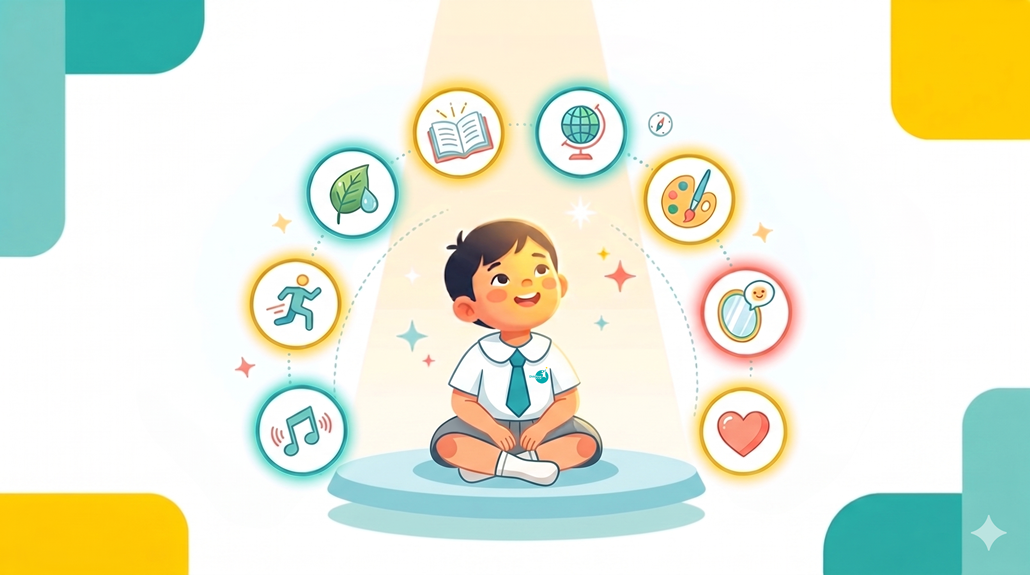
Multiple Intelligences (MI) is an educational theory proposing that human intelligence is not one general capacity but a collection of at least eight distinct cognitive strengths. Each intelligence represents a different way of processing information, solving problems, and creating things of value. Gardner defines intelligence as a biopsychological potential to process information that can be activated in a cultural setting to solve problems or create products that are valued in a culture.
The crucial implication for parents is this: every child has a unique intelligence profile. No single type is superior to another. A child who is highly Bodily-Kinesthetic is just as intelligent as one who is highly Linguistic, they simply process and express their understanding through different channels. Traditional schooling has historically favoured Linguistic and Logical-Mathematical intelligences, which is why children strong in other areas can be overlooked or underestimated.
Understanding MI theory is practical, not abstract. When you know which intelligences your child leans towards, you can choose activities, stories, games, and even conversations that speak directly to how they naturally make sense of the world. That alignment between how a child learns and how they are taught makes a remarkable difference in engagement, confidence, and long-term development.
Who Is Howard Gardner?
Howard Gardner is a developmental psychologist and professor of cognition and education at the Harvard Graduate School of Education. He first proposed the theory of Multiple Intelligences in his 1983 book Frames of Mind: The Theory of Multiple Intelligences, which quickly became a landmark reference in education, teaching, and training communities worldwide. Gardner’s central argument was that intelligence tests, such as IQ assessments, are limited to logic, mathematics, and linguistics and therefore miss the full range of human intellectual potential.
Gardner’s work has been widely embraced by educators across the globe because it validates something many teachers and parents have always sensed: children think and learn in many different ways. His theory provided a conceptual framework for designing curricula, activities, and assessments that go beyond pencil-and-paper tests and honour the breadth of children’s abilities. Although some academic researchers have debated the empirical basis of the theory, its practical value in shaping more inclusive, varied, and child-centred education has been consistently recognised.
The 8 Multiple Intelligences: A Parent’s Guide
Below is a practical overview of each intelligence type. For every one, you will find a brief description, signs to look for in your child, and a simple home activity to try. Remember that most children show strengths in several intelligences simultaneously, and all eight can be strengthened with regular, enjoyable practice.
1. Linguistic Intelligence
Also called Word Smart, this intelligence involves sensitivity to the meaning, order, sound, and rhythm of words. Children with strong Linguistic Intelligence love stories, word games, and talking through their ideas. Poets, writers, journalists, and public speakers typically excel here.
Signs to look for. Your child retells stories in detail, makes up rhymes spontaneously, enjoys being read to and asks for the same books repeatedly, or picks up new vocabulary unusually quickly, in any language.
Try at home. Take turns telling a two-sentence story, then invite your child to add the next two sentences. Build a chain of silly, imaginative tales over dinner.
2. Logical-Mathematical Intelligence
This intelligence covers the capacity for logical thinking, pattern recognition, and working with numbers and sequences. Children who are highly Logical-Mathematical display a complex form of intelligence that favours logical reasoning over imprecise assumptions in order to reach conclusions. Scientists, engineers, and mathematicians typically have this as a leading strength.
Signs to look for. Your child demonstrates problem-solving skills in mathematics, asks questions like “Why does that happen?” or “What comes next?”, enjoys sorting and categorising objects, or is curious about how machines work.
Try at home. Begin a simple pattern for your child to continue the sequence: red, blue, red, blue; big, small, big, small; circle, circle, triangle. Gradually make the patterns more complex as their confidence grows.
3. Spatial Intelligence
Spatial Intelligence is the ability to think in pictures, recall visual details, and comprehend multi-dimensional images and shapes. Children who are highly Spatial are good at remembering images and faces, and they are often skilled at visual recognition: completing jigsaw puzzles easily or recognising graphical patterns. Architects, designers, and navigators draw heavily on this intelligence.
Signs to look for. Your child enjoys drawing, is unusually skilled at puzzles for their age, builds detailed structures with blocks or LEGO, or finds their way around new places with ease.
Try at home. Give your child plain paper and ask them to draw a map of your home or a favourite park from memory. Discuss what they included and what surprised them about their own drawing.
4. Musical Intelligence
Musical Intelligence involves sensitivity to pitch, melody, rhythm, and tone. Children who are highly Musical can easily identify rhythmic and tonal patterns and pick up sounds from instruments, voices, and the environment around them. Beyond music as a hobby, this intelligence underpins a strong sense of timing, pattern, and emotional sensitivity that is valuable across many fields.
Signs to look for. Your child hums or sings throughout the day, taps rhythms on surfaces, moves to music instinctively, picks up song melodies after only one or two hearings, or is noticeably affected emotionally by music.
Try at home. Clap a rhythm and invite your child to copy it, then swap roles. Introduce simple percussion instruments, a wooden spoon and a pot will do, and take turns leading a beat.
5. Bodily-Kinesthetic Intelligence
Bodily-Kinesthetic Intelligence is the ability to use the body skillfully to solve problems and express ideas. Children who are highly Bodily-Kinesthetic often have well-developed gross and fine motor skills; they enjoy activities like crawling, jumping, climbing, and creating things with their hands. Dancers, athletes, surgeons, and craftspeople all make profound use of this intelligence.
Signs to look for. Your child finds it difficult to sit still for long periods, enjoys physical play above most other activities, shows fine-motor skill in drawing or crafts beyond their age, or learns new physical skills: swimming, cycling, with unusual ease.
Try at home. Set up a simple obstacle course in a hallway or garden. Vary the challenges each time: crawl under, jump over, balance along, and let your child teach you how they would change the course.
6. Interpersonal Intelligence
Interpersonal Intelligence is rooted in the ability to understand and relate effectively to other people. Children who are highly Interpersonal display very good verbal and non-verbal communication skills, can identify characteristics in others, and note distinctions between people. They communicate effectively and empathise easily, and they often emerge naturally as collaborators or leaders in group play.
Signs to look for. Your child is the one who mediates disputes at the playground, notices when a friend seems sad, draws other children into their games with ease, or asks thoughtful questions about how other people feel.
Try at home. Play a cooperative board game such as Snakes and Ladders or a simple card-matching game, then ask your child to explain the rules to another family member. Explain that the goal is for everyone to understand and enjoy it.
7. Intrapersonal Intelligence
Intrapersonal Intelligence is the capacity to turn inward: to develop a well-formed understanding of one’s own emotions, motivations, strengths, and weaknesses, and to use that self-knowledge to navigate life effectively. Children who are highly Intrapersonal often prefer time alone to process their thoughts, know what they like and dislike with strong conviction, and are less easily swayed by peer pressure than other children.
Signs to look for. Your child has a hobby or creative pursuit they pursue independently, talks clearly about how they feel after an upsetting or exciting event, or prefers to think before responding rather than reacting immediately.
Try at home. Keep a simple “feelings jar” together – small slips of paper where your child draws or dictates how they felt about something that happened each day. Revisit the jar weekly and talk gently about patterns they notice.
8. Naturalist Intelligence
Added by Gardner in 1995, Naturalist Intelligence describes a deep sensitivity to and appreciation for the natural world. Children who are highly Naturalist are easily able to recognise flora and fauna, are highly aware of even subtle changes in their environment, and are often drawn to animals, plants, and outdoor exploration. Biologists, environmental scientists, chefs, and landscape architects are among those who draw strongly on this intelligence.
Signs to look for. Your child stops to observe insects or plants on every walk, asks detailed questions about animals or weather, forms strong attachments to pets, or notices things in their environment that most adults walk past without seeing.
Try at home. Start a nature journal together. Collect a leaf, a pebble, or a flower on each walk and draw or describe it. Over time, your child will begin to compare, categorise, and ask questions that are genuinely scientific in their precision.
Multiple Intelligences Are Not the Same as Learning Styles
A common misconception worth clearing up: Multiple Intelligences are not the same as learning styles. Gardner himself has been clear on this point. Learning styles refer to preferences for how information is delivered — visually, auditorily, or kinaesthetically. Multiple Intelligences, by contrast, describe distinct intellectual capacities rooted in different areas of cognitive processing. A child’s intelligence profile is not simply about how they prefer to receive information; it is about the kind of thinking they naturally do well.
This distinction matters for parents because it changes how you think about support. The goal is not to find your child’s “learning style” and teach them exclusively that way. The goal is to recognise their strongest intelligences as entry points for learning, while also giving them rich experiences across all eight areas so that their full range of abilities can develop. A child who is highly Musical will likely learn to count more joyfully through rhythm than through flashcards — but that same child also benefits enormously from story-based, physical, and collaborative activities that strengthen their other intelligences too.
Why Multiple Intelligences Matter More Than Ever
In a world where artificial intelligence is automating many routine Logical-Mathematical and Linguistic tasks, the intelligences that remain irreplaceably human are becoming more valuable, not less. Creativity, empathy, physical dexterity, naturalistic awareness, and deep self-knowledge are capabilities that AI cannot replicate. These are precisely the intelligences that Gardner identified four decades ago and that remain at the heart of what it means to be human.
For Singapore parents thinking about their child’s future, this convergence is significant. The children growing up today will work in roles that require not just digital fluency but the kind of nuanced human intelligence: collaboration, creative problem-solving, emotional sensitivity, and environmental awareness, that no algorithm can replace. Nurturing MI broadly from the pre-school years is therefore not a soft educational extra. It is future-proofing your child in the deepest sense.
“Every child has a unique intelligence profile: there is no single type of smart. The question is not how intelligent your child is — it is how your child is intelligent.”
Inspired by Howard Gardner’s framework, Frames of Mind (1983).
How to Nurture Your Child’s Multiple Intelligences at Home
You do not need specialist equipment or a structured programme to begin nurturing Multiple Intelligences at home. The most powerful thing you can do is provide variety, a wide range of experiences across different domains, and observe carefully what lights your child up. Here are some practical principles to keep in mind.
- Follow their lead. Notice which activities your child gravitates towards during free play. These preferences are early signals of their strongest intelligences, and they deserve to be taken seriously rather than redirected towards “more academic” pursuits.
- Offer rotation, not repetition. Create informal zones at home: a drawing corner, a building area, a music shelf, a reading nook, a garden patch. Rotating through these regularly ensures your child receives stimulation across all eight intelligences, not just the ones they already favour.
- Reframe “struggle” as growth. When your child finds an activity difficult, try saying “Oh, that didn’t work, let’s figure out why!” rather than moving on. Gently persisting in areas that don’t come naturally helps develop the less dominant intelligences over time.
- Celebrate what they do well. A child who feels genuinely seen and celebrated for their real strengths builds the confidence to explore new areas with curiosity rather than fear. Praise effort and process, not just outcome.
- Remember that intelligence grows. A child’s intelligence profile is not fixed. It develops with encouragement and opportunity. The activities you provide today shape the profile your child carries into school, adolescence, and adult life.
Observing your child in play is the most reliable assessment method available to parents. Watch what they choose when nothing is expected of them, and you will learn more about their intelligence profile than any standardised test can reveal.
How ChildFirst Puts Multiple Intelligences into Practice
At ChildFirst, Multiple Intelligences is not just a buzzword on a brochure — it is one of the three core pillars of everything we do. Our Multiple Intelligences curriculum engages every child in over 100 MI activities each year, all carefully designed to continuously exercise their minds and strengthen their unique talents. Each activity is structured so that dominant intelligences become stronger while weaker intelligences are gently awakened, giving every child the full cognitive breadth they need to thrive.
Our thematic approach introduces children to topics centred around their everyday world, such as the World of Animals, Food, and Transportation, so that MI learning feels meaningful and directly connected to real life. This context helps young brains make connections faster and retain what they learn more deeply.
ChildFirst’s Three-Pronged Trilingual Curriculum
Three pillars, working together to future-proof your child.
Artificial Intelligence curriculum: coding as the third language, digital literacy, and computational thinking.
Human Intelligence curriculum: creativity, critical thinking, and the irreplaceable skills that set humans apart.
Multiple Intelligences curriculum: nurturing every child’s unique profile across all eight intelligence types.
ChildFirst • Trilingual AI + HI + MI Curriculum • Singapore Pre-school.
What makes ChildFirst’s approach genuinely distinctive is the way MI is integrated with our trilingual model – English, Chinese, and Coding as the third language – and with our Human Intelligence curriculum. Linguistic Intelligence is developed simultaneously in two spoken languages through our English and Mandarin immersion programmes, while Logical-Mathematical Intelligence finds a natural expression in our Coding curriculum – where children learn to think algorithmically from as young as 18 months. Our EdnoLand curriculum technology and EdnoAI applications create a personalised learning environment that adapts to each child’s developing profile, tracking progress across intelligences and ensuring no area is left unattended.
Both our Hillview and Tampines centres are SPARK-certified and Healthy Pre-school accredited, and we welcome children from 18 months through to Kindergarten 2. Every centre operates a structured MI programme within the broader trilingual framework, so your child experiences a coherent, progressive approach to intelligence development from their very first day with us.
Key Takeaways for Parents
- Every child has a unique intelligence profile: there is no single type of smart.
- Intelligence is not fixed: it grows with encouragement, variety, and the right opportunities.
- Observe, don’t just test: free play reveals more about your child’s intelligences than any assessment.
- Strength and variety both matter: lean into your child’s natural intelligences as entry points, then gently expand into the others.
- MI is future-ready learning: the human intelligences Gardner identified are precisely those that AI cannot replicate.
Howard Gardner gave parents and educators a gift in 1983: the language to see every child as genuinely, multiply intelligent. In a world moving as fast as ours, that perspective is not just heartwarming – it is essential. When you choose an early childhood programme that takes Multiple Intelligences seriously, you are choosing a future where your child knows what they are good at, believes in their own abilities, and has the breadth of skills to meet whatever the world asks of them.
Trust the process, trust your child, and trust yourself.
Want to See How We Bring Multiple Intelligences to Life for Your Child?
Come and see ChildFirst’s AI + HI + MI trilingual curriculum in action. Our educators would love to show you how we discover and nurture every child’s unique intelligence profile – and how our EdnoLand curriculum technology and EdnoAI applications personalise the journey from day one.
ChildFirst • Trilingual AI + HI + MI Curriculum • Singapore Pre-school.