
Ages 3 to 6 · Nursery 1 to Kindergarten 2
Happy every day, and ready to start Primary 1 well.
A trilingual start: half the day in English and half in Chinese, with robotics and AI built on human thinking first. Children take the lead in their own learning.
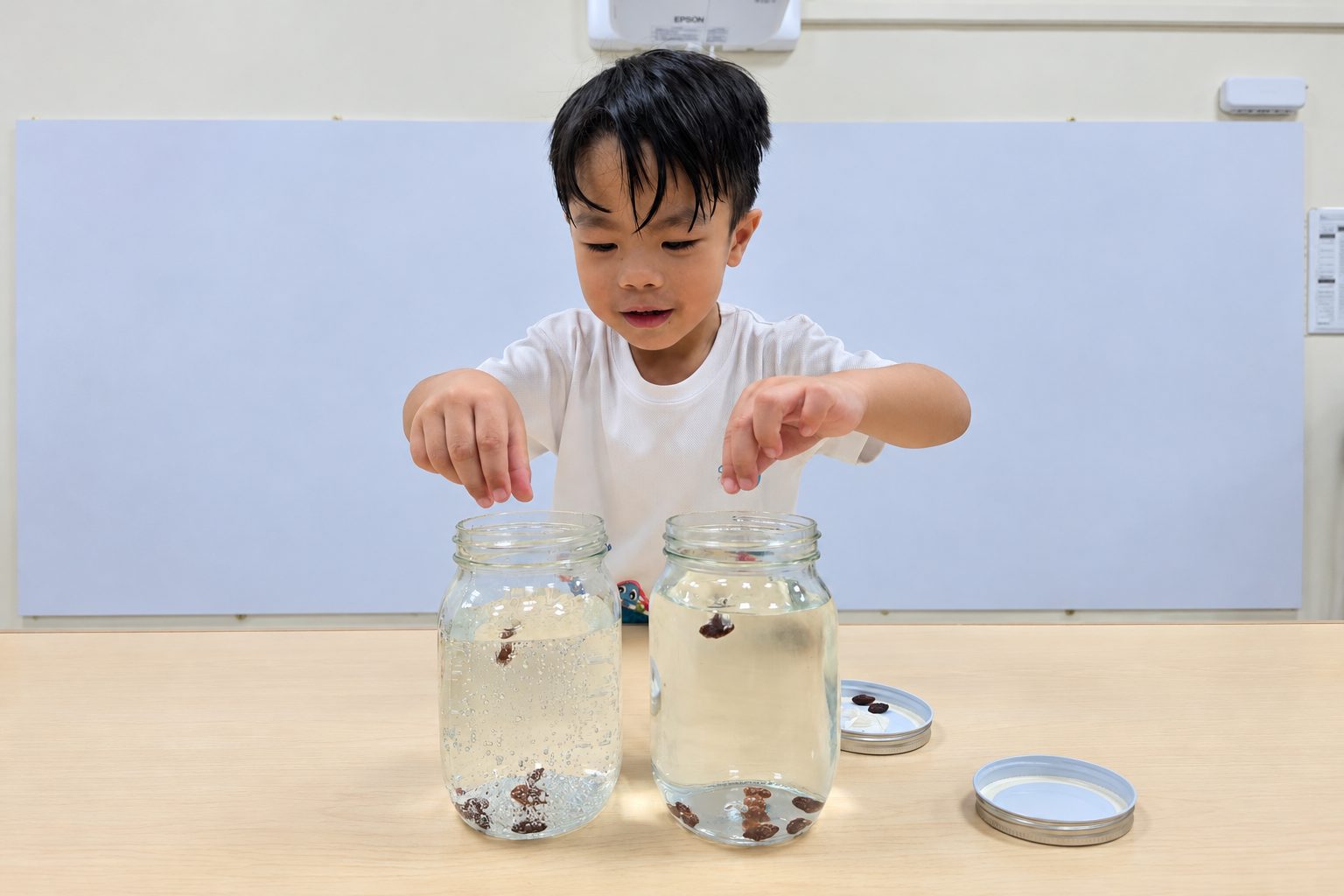 I am full of ideas!
See Chinese learning in action
Effect of half-a-day Chinese immersion
Our unique method of teaching Chinese word recognition
What to expect from 3 to 6
I am full of ideas!
Children now plan, imagine and start things for themselves, and when their ideas are welcomed they gain confidence and a sense of purpose. From Nursery to Kindergarten they move from asking questions to investigating ideas and solving problems, with more responsibility for their own learning. They build strong English and Chinese, and the character and resilience to thrive in Primary 1 and beyond, guided by Singapore's Nurturing Early Learners (NEL) Framework.
What parents wonder, what your child needs, and what we do
In the classroom
Settling in
Whether your child joins at N1, N2, K1 or K2, from another school or from home, three gentle steps help them feel at home before and after day one.
A free trial lesson
During the school tour you are invited to arrange a 1-hour trial lesson, in English, in Mandarin, or in both, as you prefer. Your child joins the class activities, meets the teachers and gets used to the room before you enrol.
An orientation visit
Two weeks before the start date, you and your child are invited to visit the centre. Meet and speak with the class teachers, say hello to future classmates, and buy the school uniforms.
Parents welcome on days 1 and 2
You are welcome to stay with your child for the first two days, for reassurance. Our teachers offer gentle guidance and encouragement so each child settles in, builds confidence and feels secure.
For shy children, or those with separation anxiety: gentle transitions, consistent routines and close communication with you, with teachers working patiently with each child.
Progress reports and portfolios
Teachers regularly observe and assess each child's learning and development across the learning domains. A learning portfolio and a developmental checklist are prepared to record your child's progress, achievements and areas for further development.
We share and discuss them with you at our Parent-Teacher Conferences, held twice a year, in May and November. It is a chance to exchange feedback, celebrate your child's milestones and plan together how to support their learning.
The checklist covers seven areas: Aesthetics & Creative Expression, Discovery of the World, Health, Safety & Motor Skills Development, Numeracy, Language & Literacy (English), Chinese, and Social & Emotional Development. Each skill is marked at mid-year and year-end: Exceeding, Meeting, Working Towards, or Not Yet Evident.
The progress report
The learning portfolio
Sample pages: the blank Nursery 2 Progress Report, and a Nursery 2 learning portfolio in which the child's name is covered and faces are hidden. Tap a page to enlarge.
The practical questions
Health and safety
- Meals cooked in our in-house kitchen at every centre.
- CCTV and controlled access.
- We tell you straight away if your child is unwell.
Communication with parents
- Photos and updates through the parent app.
- Regular updates through the parent communication app, parent-teacher sessions, and teachers available to discuss progress through the year. Parents can also volunteer and join school activities.
- Progress reports and portfolios, discussed at the Parent-Teacher Conferences in May and November.
Our curriculum from 3 to 6
Stages in grey come later in your child’s journey. The full journey is on the curriculum page.
Human Intelligence
How we develop Human Intelligence →In the age of AI, human intelligence matters more than ever. Curiosity, judgement, wisdom and creativity are what set a child apart from AI, so we build them first, from the earliest months.
Multiple Intelligences
How we develop Multiple Intelligences →Every child is different. We develop the uniqueness of each child, discovering and nurturing their own strengths across eight intelligences, rather than measuring everyone against one standard.
The eight intelligences, including music and art (picture smart), all run from 2 months to 6 years.
Three of the most important languages in the world: English for communication, Chinese for language and culture, and AI for future readiness. English and Chinese are half a day each from 18 months, and AI joins gradually from age 3.
English (half a day from 18 months)
How we teach English →Chinese (half a day from 18 months)
How we teach Chinese →AI (gradually from age 3, starting from screen-free)
How we teach AI →What parents say
“Her confidence and curiosity have grown tremendously. She has built wonderful friendships, learned to work in teams, and developed a genuine love for problem-solving.”
“…my child has blossomed since joining the school in k1.”
“The curriculum is structured and our son really enjoys the robotics portion especially.”
Questions parents ask
Will my child be ready for Primary 1?
Guided by Singapore's NEL framework. K2 children master more than 50% of the Primary 1 Chinese vocabulary before they enter P1.
Is Chinese too much if we don't speak it at home?
Half the day is in Chinese, with AI Chinese that revises each child's own weak words.
How much screen time and AI is there?
Coding is screen-free at N1 and N2. Screen use for coding starts at K1 with up to 1 hour a week, well below the MOH guideline of 1 hour a day.
Is robotics and AI a gimmick?
Three-time Overall Champion at the National Robotics Competition, plus the Science Centre coding certification and inter-school competitions.
Will it feel like pressure?
"We are stretching our children, not stressing them."
Can my child join from another school, and is there a trial?
Yes. During the school tour you can arrange a free 1-hour trial lesson in English, Mandarin or both. Two weeks before the start date we invite you and your child to an orientation visit, and you are welcome to stay with your child for the first two days.
Is ChildFirst a bilingual preschool?
Yes. From 18 months, children spend half the day in English and half in Chinese, a bilingual start. AI is then added gradually from N1 (age 3) as the third language, so ChildFirst is bilingual first and trilingual gradually from N1.
See it for yourself
Come and see a class in action. Planning ahead? Tell us when you would like your child to start, and we will get in touch about 5 to 6 months before.